Aligning Sales, Marketing & Customer Success for Revenue Growth
How to Align Sales, Marketing, and Customer Success
Last updated: June 1, 2026
Quick answer
Sales, marketing, and customer success alignment works when all three teams use the same lifecycle stages, handoff rules, routing logic, SLAs, and customer feedback loops.
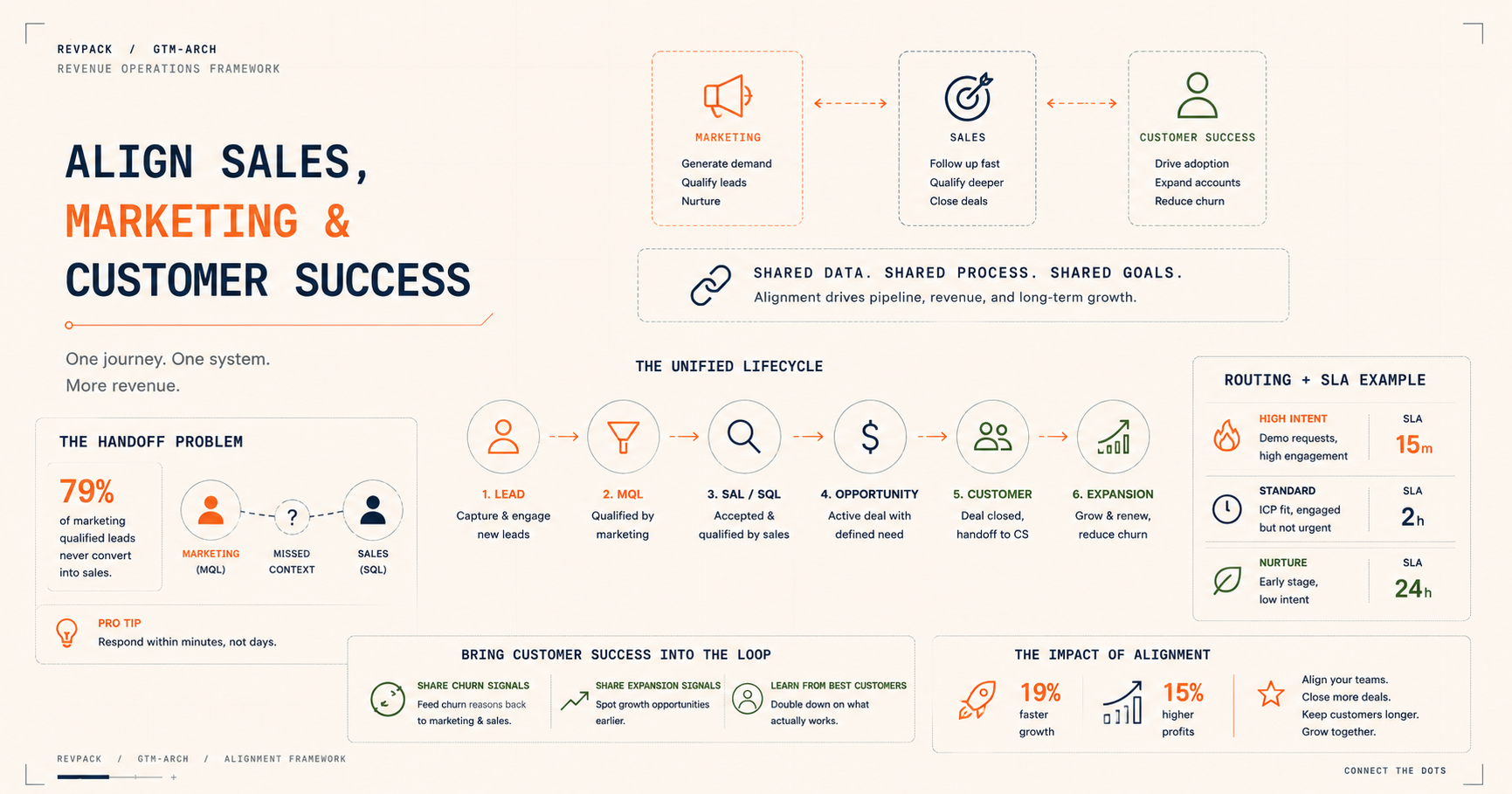
Most GTM teams do not have a strategy problem, but have a handoff problem. Marketing sends leads to sales without enough context, than ales follows up too late or does not trust the lead quality, customer success sees churn risks and expansion signals that never make it back into acquisition strategy.
A strong RevOps system fixes this by creating one shared revenue process from first touch to renewal.
Best for
This guide is for B2B SaaS, tech, and agency teams that have messy handoffs between marketing, sales, and customer success.
RevPack angle
RevPack helps B2B teams connect HubSpot, Salesforce, enrichment tools, routing logic, dashboards, and automation so revenue teams can work from one shared system.
Why GTM alignment breaks
Most companies say they want sales and marketing alignment.
The problem usually appears in the handoff.
Marketing says a lead is qualified.
Sales says the lead is not ready.
Customer success sees patterns that never reach marketing.
Leadership gets three different versions of the truth.
This creates simple but expensive problems:
- Leads sit too long before sales follows up
- Sales does not know why a lead was qualified
- Marketing optimizes for MQLs instead of revenue
- Customer success feedback never improves targeting
- Reports do not match across teams
- Nobody agrees who owns the next step
The fix is not another meeting.
The fix is a shared revenue operating system.
What is GTM alignment?
GTM alignment means sales, marketing, and customer success work from the same customer journey.
That means everyone agrees on:
- Lifecycle stages
- Entry and exit criteria
- Lead ownership
- Routing rules
- Follow-up SLAs
- Required CRM fields
- Reporting definitions
- Expansion and churn signals
- What happens after every handoff
When these rules are clear, the customer journey becomes easier to manage.
The main cause of poor alignment: bad handoffs
A handoff is the moment one team passes a prospect or customer to another team.
Examples:
- Marketing passes an MQL to sales
- SDR passes an SQL to an account executive
- Sales passes a new customer to onboarding
- Customer success passes an expansion opportunity to sales
These moments are where revenue leaks happen.
Common handoff problems
ProblemWhat happensNo clear qualification criteriaSales ignores leads marketing thinks are readyMissing contextReps do not know what the person downloaded, clicked, or asked forSlow response timeWarm leads go cold before anyone follows upWrong ownerLeads sit in the CRM without actionDifferent lifecycle definitionsTeams report different numbersNo SLANobody knows how fast follow-up should happenNo feedback loopMarketing keeps sending poor-fit leads
If handoffs are unclear, the funnel becomes messy.
Build one lifecycle system
The first step is to create one shared lifecycle.
Do not let every team invent its own stages.
A simple B2B lifecycle can look like this:
StageOwnerWhat it meansVisitorMarketingSomeone visits or engages with your contentLeadMarketingSomeone gives contact informationMQLMarketingThe lead matches your ICP and shows intentSALSDR or SalesSales accepts the lead for follow-upSQLSalesThe lead is qualified through conversationOpportunitySalesThere is a real deal with clear next stepsCustomerSales / CSThe deal is closed wonExpansion opportunityCS / SalesThe account shows upsell or cross-sell potential
The names matter less than the rules behind them.
Each stage needs:
- Clear entry criteria
- Clear owner
- Clear next step
- Clear SLA
- Clear CRM fields
- Clear reporting logic
This makes the funnel easier to manage and easier to improve.
Set simple handoff rules
Once the lifecycle is clear, define handoff rules.
For example:
MQL to sales
A lead becomes sales-ready when:
- The company fits your ICP
- The person has a relevant role
- The account shows meaningful intent
- Required CRM fields are complete
- The lead source is known
- The next step is clear
Sales accepted lead
Sales accepts the lead when:
- The account owner is assigned
- The rep has enough context
- The first follow-up task is created
- The lead is contacted within the SLA
SQL to opportunity
A lead becomes an opportunity when:
- There is a clear business problem
- The right person is involved
- There is a timeline
- There is a next meeting or buying process
- The deal has real potential
These rules remove guesswork.
Build routing that actually works
Lead routing should be simple enough to understand and strong enough to handle real life.
Good routing can use:
- Geography
- Company size
- Industry
- Product interest
- Lead source
- Intent level
- Account ownership
- Existing customer status
- Rep availability
- Territory rules
The goal is simple:
The right lead should reach the right person quickly.
Example routing logic
Lead typeRoute toSLAHigh-intent demo requestSales or SDR15 minutesICP-fit content leadSDR2 business hoursExisting customer expansion signalCustomer success or account manager1 business dayPoor-fit leadNurture workflowNo sales taskPartner referralAssigned ownerSame business day
This prevents good leads from getting lost.
Use SLAs to keep follow-up consistent
An SLA is a simple rule for how fast a team should act.
Without SLAs, follow-up depends on memory and mood.
With SLAs, everyone knows what should happen.
Basic SLA example
Lead priorityResponse timeFollow-up ruleHigh-intent lead15 minutesCall, email, LinkedIn, then task escalationStandard qualified lead2 hoursEmail and call same dayNurture leadNext business dayAdd to sequence or workflowExpansion signal1 business dayCS reviews and routes if relevant
You do not need a complicated SLA system to start.
You just need clear rules and a dashboard that shows when they are missed.
Bring customer success into the loop
Customer success often has the best information in the company.
They know:
- Which customers succeed fastest
- Which customers churn
- Which use cases expand
- Which objections create problems later
- Which features drive adoption
- Which customer types are a bad fit
- Which accounts show expansion potential
This information should improve your marketing and sales strategy.
If CS sees that a certain type of customer always churns, sales should qualify those accounts more carefully.
If CS sees that one segment expands quickly, marketing should target more companies like that.
If CS sees a common onboarding blocker, sales should set better expectations before the deal closes.
That is how you close the loop.
Customer success feedback loops to build
Here are the simplest CS feedback loops to create.
1. Churn feedback
When a customer churns, capture:
- Churn reason
- Company type
- Use case
- Original source
- Sales owner
- Main expectation gap
- Product or service blocker
Use this to improve qualification.
2. Expansion feedback
When a customer expands, capture:
- Expansion trigger
- Team growth
- New use case
- Adoption milestone
- Stakeholder change
- Budget timing
Use this to improve lead scoring and account targeting.
3. Best-customer feedback
Look at your best customers and identify patterns:
- Industry
- Company size
- Tool stack
- Sales motion
- Buying trigger
- Use case
- Time to value
- Expansion path
Use this to refine your ICP.
The RevOps alignment checklist
Use this checklist to see where your system is broken.
Lifecycle
- Do all teams use the same lifecycle stages?
- Does every stage have clear criteria?
- Is there a clear owner for each stage?
- Are lifecycle changes automated in the CRM?
Handoffs
- Does sales know why a lead became qualified?
- Are required fields completed before handoff?
- Are follow-up tasks created automatically?
- Are rejected leads sent back with a reason?
Routing
- Are leads routed by fit, intent, territory, and owner?
- Are high-intent leads prioritized?
- Are existing customers routed differently?
- Is there a backup owner if someone is unavailable?
SLAs
- Do you know how fast sales follows up?
- Can managers see missed SLAs?
- Are high-intent leads handled faster?
- Are stale leads recycled automatically?
Customer success
- Are churn reasons captured?
- Are expansion signals sent back to sales?
- Are success patterns used in marketing?
- Are poor-fit patterns used in qualification?
Common mistakes
Mistake 1: Optimizing for MQLs
MQLs are useful, but they are not the goal.
The goal is qualified pipeline and revenue.
Mistake 2: No sales acceptance step
If sales does not accept or reject leads with a reason, marketing never learns what quality means.
Mistake 3: Manual routing
Manual routing works at the beginning. It breaks when volume grows.
Mistake 4: No SLA dashboard
If nobody tracks follow-up speed, good leads will go cold.
Mistake 5: Ignoring customer success data
CS knows which customers succeed, expand, and churn. That information should shape acquisition.
FAQ
What is sales and marketing alignment?
Sales and marketing alignment means both teams use the same lifecycle stages, qualification criteria, lead handoff rules, and revenue goals.
Why do sales and marketing handoffs fail?
Handoffs fail when teams disagree on what a qualified lead means, when CRM data is incomplete, when routing is unclear, or when sales follow-up is too slow.
What is a Sales Accepted Lead?
A Sales Accepted Lead, or SAL, is a lead that sales has reviewed and accepted for follow-up. It creates accountability between marketing qualification and sales action.
How do SLAs improve RevOps?
SLAs create clear expectations for follow-up speed and ownership. They help teams respond faster and prevent qualified leads from sitting untouched.
Why should customer success be part of GTM alignment?
Customer success sees churn risks, expansion signals, and best-customer patterns. Those insights help marketing target better accounts and help sales qualify more accurately.
How can RevPack help?
RevPack helps B2B teams design lifecycle stages, fix CRM handoffs, automate routing, monitor SLAs, connect customer success feedback, and build dashboards across HubSpot, Salesforce, and other GTM tools.
Final takeaway
GTM alignment gets much easier when the process is visible.
Define one lifecycle.
Set clear handoff rules.
Route leads properly.
Track SLAs.
Bring customer success feedback into marketing and sales.
That is how you turn separate teams into one revenue system.
Want to fix your sales, marketing, and CS handoffs?
RevPack helps B2B SaaS, tech, and agency teams build cleaner revenue systems across sales, marketing, and customer success.
We help with:
- Lifecycle design
- HubSpot and Salesforce cleanup
- MQL, SAL, SQL definitions
- Lead routing
- SLA dashboards
- Customer success feedback loops
- Expansion signal tracking
- RevOps reporting
- GTM automation
Book a 20-minute RevOps alignment call.
- DataAxle USA — "43 Lead Generation Statistics for Sales Representatives in 2025," 2025
- Forrester — "Sales and Marketing Alignment Research," 2023
- Gainsight — "Customer Success Research Report," 2024
- InsideSales.com — "Lead Response Management Study," 2023
- LinkedIn — "Sales and Marketing Alignment Research," 2023
- MarketingSherpa — "B2B Lead Generation Benchmarks," 2024
- PointClear — "What Percentage of Marketing Leads Should Be Accepted by Sales," 2024
- Salesgenie — "20 Marketing Qualified Lead Statistics in 2025," 2025
- SiriusDecisions — "Lead Management Process Impact Study," 2024
- ZoomInfo — "Sales and Marketing Alignment Statistics," 2025
- Unified lifecycle schema eliminates handoff confusion and creates shared GTM language with measurable impact
- Intelligent routing with bulletproof SLAs ensures high-intent leads receive immediate attention and convert 67% better
- Customer success feedback loops improve both lead quality and expansion revenue performance with 125% higher retention