Should Midsize Tech Teams Choose HubSpot or Pipedrive in 2026?
TL;DR
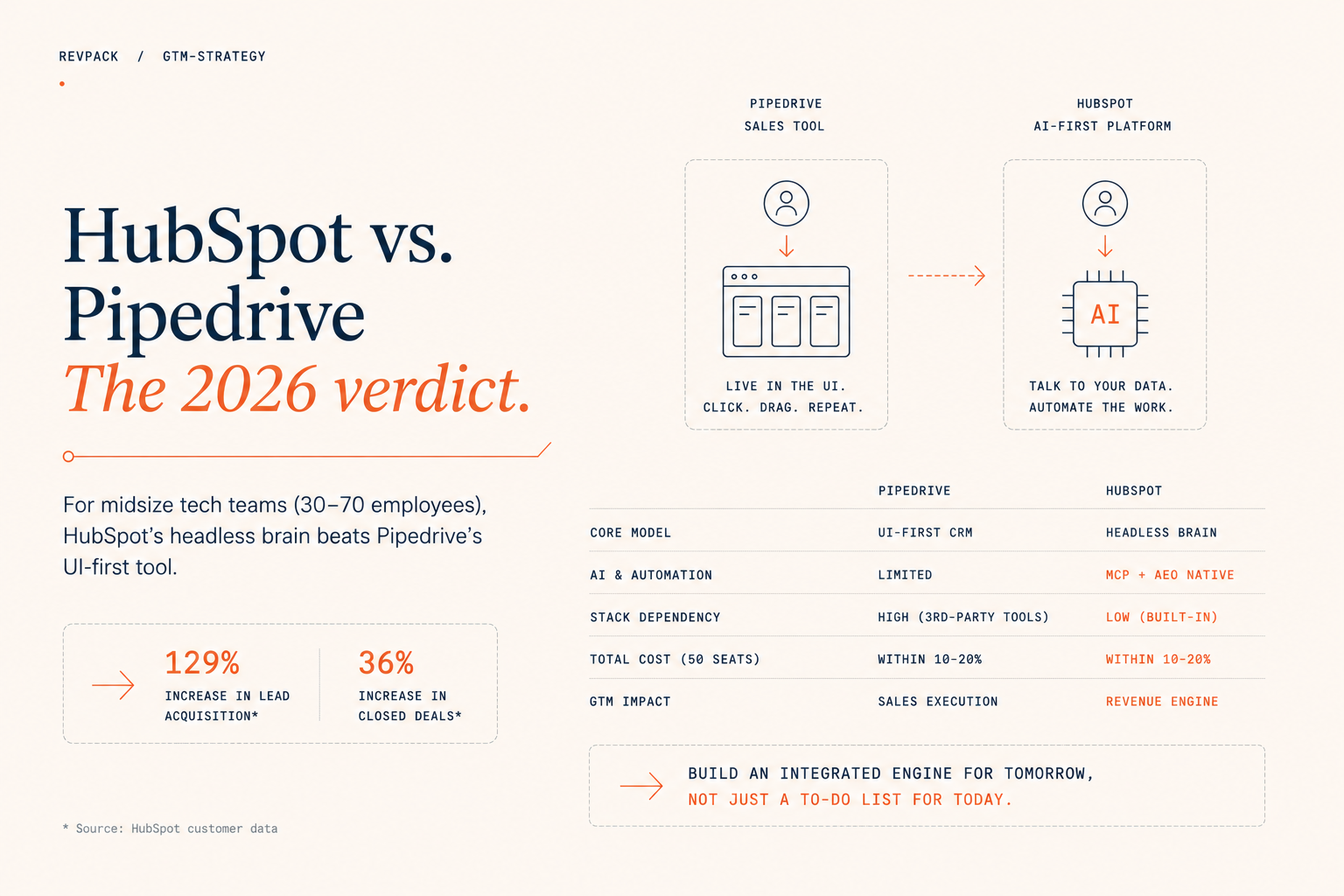
HubSpot is the superior choice for midsize tech teams (30–70 employees) because it has evolved from a traditional database into an AI-first "headless brain." While Pipedrive remains an excellent tool for pure sales execution, HubSpot’s integration of the Model Context Protocol (MCP) and allows it to automate GTM mechanisms that Pipedrive’s UI-driven model cannot match.
The Convergence of Cost and Capability
For a 50-person organization, the assumed "Pipedrive discount" is often an illusion. While Pipedrive’s sticker price is lower, a midsize tech team typically requires a third-party stack-marketing automation (ActiveCampaign), helpdesk (Zendesk), and middleware (Zapier)-to match HubSpot’s native breadth.
Across a modeled 45-user organization, Pipedrive’s total cost of ownership (TCO) lands within 10–20% of HubSpot’s once you account for these integrations and the "rep tax" of managing disconnected data. In fact, HubSpot’s own data suggests users see a 129% increase in lead acquisition and a 36% increase in closed deals within one year, often offsetting the initial price gap.
Why the AI-First "Headless Brain" Changes the Decision
The most significant differentiator in 2026 isn't the UI; it’s the protocol. Pipedrive forces your team to live inside their interface-dragging cards and clicking through visual pipelines. HubSpot has shifted the paradigm by leaning into the Model Context Protocol (MCP).
The MCP Mechanism: By using a remote MCP server, you turn the CRM into a platform you can simply talk to. You can connect an AI agent (like Claude or Breeze) to bypass the UI entirely, prompting it to "Update all deals in negotiation to 50% probability and draft follow-up emails based on last call notes".
Comparison: Platform vs. Sales Tool
| Dimension | HubSpot (AI-First Platform) | Pipedrive (Sales-First CRM) | RevPack Analytical Take |
|---|---|---|---|
| Core Mechanism | Relational database with custom objects. | Activity-based selling on fixed entities. | HubSpot wins for "weird" or complex business models. |
| AI Maturity | Breeze AI & MCP: Headless, agentic automation. | Sales Assistant: Narrow, rep-focused productivity. | HubSpot treats AI as an architect; Pipedrive treats it as an assistant. |
| GTM Alignment | Native marketing, sales, and service on one data model. | Sales-centric; requires "best-of-breed" bolt-ons. | HubSpot eliminates the sync-lag that breaks GTM velocity. |
| Scaling Ceiling | Built for 50–200+ employees. | Common "scaling cliff" at 30–50 reps. | Pipedrive's 2025 automation caps create a hard ceiling for growth. |
The "Rep Tax" and Implementation Speed
Pipedrive wins on initial adoption speed, often going live in days. However, for a tech team scaling toward 100 people, this early speed often leads to a "forced migration" later as reporting and territory management needs become more sophisticated.
HubSpot implementations take longer (6–12 weeks) and carry mandatory onboarding fees, but they de-risk the technical debt of a fragmented stack. The goal is to build an integrated revenue operations engine for tomorrow, not just a to-do list for today.
Frequently Asked Questions
What is the Model Context Protocol (MCP) in HubSpot?
MCP is a protocol that allows AI agents to interact directly with HubSpot’s data layer. It transforms the CRM from a database that requires manual maintenance into a "headless brain" that can execute complex tasks via simple prompts rather than manual UI clicks.
Does Pipedrive's cost advantage hold for 50+ seats?
Rarely. While the per-seat cost is lower, midsize teams usually end up paying for third-party marketing and service tools to match HubSpot's native functionality. Once you factor in middleware costs and data-sync overhead, the TCO gap often shrinks to 10–20%.
What are the main "hidden costs" in HubSpot?
The primary risks are the "marketing contacts trap," where costs jump automatically when you hit database thresholds, and mandatory professional onboarding fees ($1,500–$3,000). We recommend disciplined contact hygiene to mitigate these costs.
This analysis is grounded in 2026 list pricing, technical documentation, and peer-reviewed research on generative search behavior.
Aggarwal et al. (2024): Generative Engine Optimization (GEO). Proceedings of the 30th ACM SIGKDD Conference on Knowledge Discovery and Data Mining.
https://arxiv.org/abs/2311.09735
Gartner (2025): Magic Quadrant for B2B Marketing Automation Platforms (September 23, 2025) and Magic Quadrant for Sales Force Automation (August 2025).
https://www.gartner.com/en/research/magic-quadrants
HubSpot Technical Documentation: Model Context Protocol (MCP) Remote Server documentation and Breeze Intelligence Credits documentation.
https://developers.hubspot.com/docs/apps/ai/model-context-protocol
https://knowledge.hubspot.com/account/breeze-intelligence-credits
HubSpot Official Pricing: Sales Hub Professional and Marketing Hub Professional Product & Services Catalog.
https://legal.hubspot.com/hubspot-product-and-services-catalog
Pipedrive Official Pricing: 2026 plan structure and Campaigns add-on documentation.
https://www.pipedrive.com/en/pricing
https://www.pipedrive.com/en/features/email-marketing-software
Case Evidence
2030 Builders: HubSpot customer case study.
https://www.hubspot.com/case-studies/2030-builders
Top Tier Public Adjusters: Pipedrive customer case study.
https://www.pipedrive.com/en/case-studies/top-tier-public-adjusters
Third-Party Review Data
G2 CRM Grid for Mid-Market (2025–2026):
https://www.g2.com/categories/crm
Capterra CRM User Sentiment Index:
https://www.capterra.com/customer-relationship-management-software/
API Standards
Pipedrive Token-Based Rate Limiting Documentation:
https://pipedrive.readme.io/docs/core-api-concepts-rate-limiting
HubSpot CRM API Scopes Documentation:
https://developers.hubspot.com/docs/apps/developer-platform/build-apps/authentication/scopes