How do top RevOps teams optimize workflows?
TL;DR
Top RevOps teams optimize by time-cost, not by annoyance. They audit where hours actually go, fix the highest-cost manual workflows first (automate or eliminate), and measure the time saved so the next priority is obvious. The trap is polishing the workflow that irritates someone loudest instead of the one quietly eating the most hours across the team.
Optimize the expensive one, not the annoying one
Every team has a workflow someone complains about. It's rarely the one costing the most time. RevOps efficiency comes from a boring discipline: measure where hours go, rank by total cost, and fix the top of that list. A mildly annoying task done twice a month matters less than a tolerable one done 50 times a day across the team.
This matters because reps already spend only about 30% of their time selling. Every manual workflow you remove is selling time given back — but only if you target the ones that actually add up.
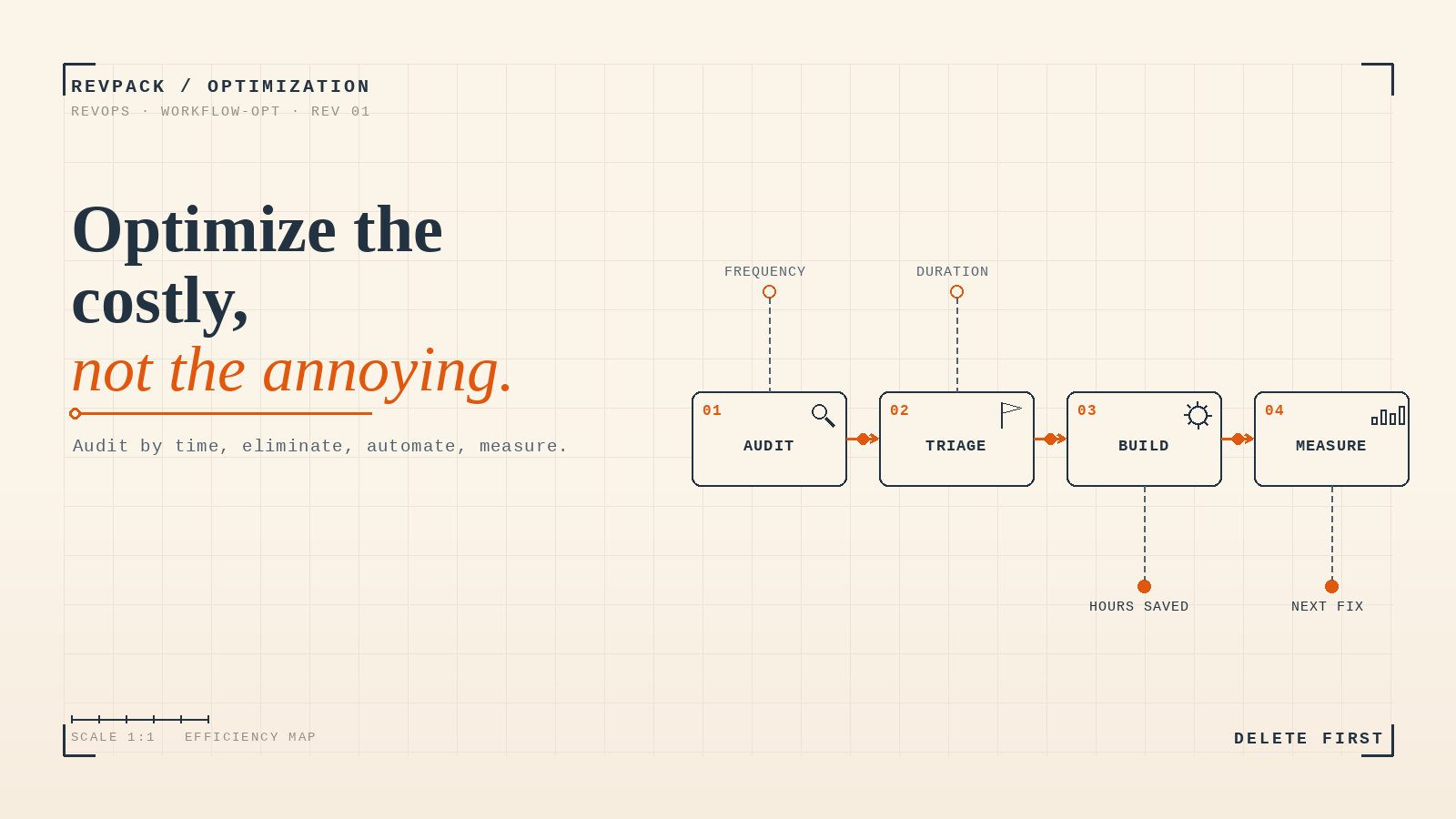
The optimization loop
| Step | What you do | Output |
|---|---|---|
| 1. Audit | Map workflows and time per run | A ranked cost list |
| 2. Triage | Automate, simplify, or eliminate | A fix per top item |
| 3. Build | Ship the fix with QA | A reliable workflow |
| 4. Measure | Track hours saved | Proof + next priority |
Eliminate before you automate
The fastest optimization is deletion. Before automating a workflow, ask whether it needs to exist — half of "essential" RevOps tasks are reports nobody reads or fields nobody uses. Automating a useless workflow just makes waste run faster. Kill what you can, simplify what's left, automate what remains.
Measure the saving or it didn't happen
"We automated lead routing" is a task. "We cut routing from two hours a day to zero" is a result that justifies the next project and proves RevOps's value. Track time saved per fix. It turns optimization from invisible plumbing work into a visible, fundable program — and it tells you where the next hour is hiding.
What to do this week
Ask your team to log, for three days, the repetitive tasks they do and roughly how long each takes. Add it up and rank it. The top one or two items are your optimization roadmap — and they're almost never the tasks people complain about most.
Frequently asked questions
How do you prioritize which workflows to optimize? By total time cost — frequency times duration across the team — not by how annoying a task feels. A tolerable task done many times daily usually outranks a frustrating one done occasionally.
Should you automate every manual workflow? No. Eliminate unnecessary ones first, simplify what's left, then automate the rest. Automating a workflow nobody needs just makes waste faster.
How do you prove RevOps optimization worked? Measure hours saved per fix. It converts optimization from invisible work into a fundable program and points you to the next-highest-cost workflow to tackle.
How RevPack helps
We run workflow optimization as a program: time-cost audit, eliminate-simplify-automate triage, reliable builds, and measured hours saved. If your team is busy but buried in manual work, we find the expensive workflows and give the time back.
- Salesforce — "Sales Statistics / State of Sales" (reps spend ~30% of time selling). salesforce.com
- Gartner — "Revenue Operations: The What, Best Practices & RevOps Guide." gartner.com
Top RevOps teams optimize by time-cost, not annoyance: audit where hours go, rank by total cost, eliminate or automate the most expensive workflows, and measure the time saved. Delete before you automate, and prove the saving so optimization becomes a fundable program.