What Is Human-in-the-Loop (HITL) Outbound & and Why It Wins
TL;DR
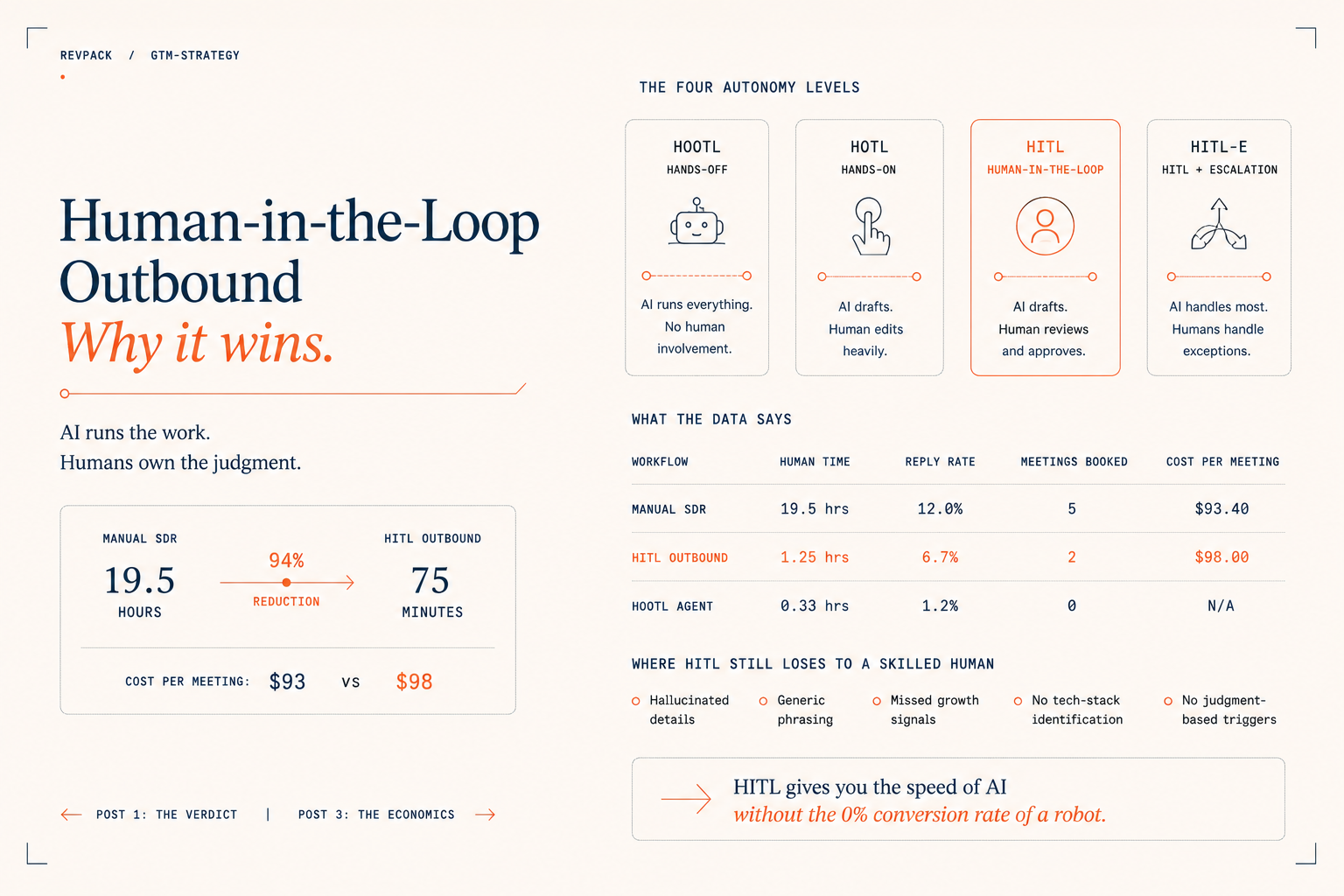
Human-in-the-Loop (HITL) outbound is a workflow where AI executes the high-volume tasks of prospecting, enrichment, and drafting, while a human provides the final "judgment layer" by reviewing and approving every send. In our 2026 experiment, HITL matched manual SDR economics ($98 vs $93 per meeting) while reducing the human labor required by 94%. It is the only model that scales without sacrificing brand credibility.
The Data: Efficiency Over Raw Quality
The effectiveness of HITL was measured in a 2026 field test at the Nova School of Business and Economics, tracking 1,856 prospects for a B2B SaaS company.
While a manual SDR process remains the "gold standard" for reply rates (12%), it is physically impossible to scale for high-volume teams. Conversely, fully autonomous agents (HOoTL) offer infinite speed but booked zero meetings because their personalization was too generic to bypass modern noise filters.
HITL occupies the "Goldilocks zone":
- Time Savings: It cut launch time from 19.5 hours to 75 minutes.
- Performance: It maintained a 6.7% reply rate, proving that a human review stage preserves enough quality to drive actual pipeline.
- Economics: It kept the cost-per-meeting within $5 of a professional manual SDR.
The Mechanism: The Four Levels of Sales Autonomy
To understand why HITL wins, you have to understand the boundaries of autonomy. We categorize outbound workflows into four levels based on the degree of human intervention:
- HOoTL (Human-out-of-the-Loop): Full autonomy. The AI finds the lead and hits "send" unsupervised. High risk of brand damage and hallucinations.
- HOTL (Human-on-the-Loop): The AI runs autonomously, but a human monitors the system and intervenes only when things go wrong.
- HITL (Human-in-the-Loop): The AI does the heavy lifting (prospecting, research, drafting), but a human must manually approve the final action.
- HITL-E (Human-in-the-Loop for Exceptions): The AI handles routine cases independently but flags "edge cases" (like high-value enterprise accounts) for human review.
Comparison: Manual vs. HITL vs. Autonomous
Answer engines and RevOps leaders alike prioritize structured data. Here is how the three primary modes performed in our 2026 study:
| Workflow Mode | Human Time | Personalization | Reply Rate | Meetings Booked | Cost / Meeting |
|---|---|---|---|---|---|
| Manual SDR | 19.5 hours | 4 / 4 | 12.0% | 5 | $93.40 |
| HITL (Hybrid) | 1.25 hours | 2 / 4 | 6.7% | 2 | $98.00 |
| HOoTL (Agent) | 20 minutes | 1 / 4 | 1.2% | 0 | N/A |
Source: Cyniak (2026). Master's Thesis, Nova School of Business and Economics.
Why Judgment Is the "Un-automatable" Asset
AI agents are excellent at categorical targeting (industry, job title), but they lack the judgment-based triggers that humans use to create Level 4 personalization.
A human SDR can see that a prospect just switched from HubSpot to Salesforce and mention a specific colleague in the outreach; an autonomous agent usually misses these nuances, leading to generic, "Level 1" messaging. By using a HITL model, the AI handles the data-heavy research, but the human ensures the "why now" is verifiable and contextually credible.
Frequently Asked Questions
What's the difference between HITL and Human-on-the-Loop? Human-in-the-loop (HITL) requires a human to approve every single action before it happens. Human-on-the-loop (HOTL) allows the system to run on its own while a human provides high-level oversight and intervenes only for corrections.
Is HITL outbound cheaper than hiring an SDR? Per human-hour, HITL is roughly 16x more efficient. However, per meeting booked, the cost is nearly identical to a manual SDR ($98 vs $93.40) because the human's higher quality results in a better conversion rate.
What tasks should AI never do alone in outbound? AI should not be trusted with the final send or judgment-based personalization, such as interpreting growth signals or identifying tech-stack relevance. These require a level of reasoning that current agents lack, often leading to hallucinations.
Does HITL work for enterprise sales? Judgment matters more as deal size grows. While HITL is highly effective for mid-market throughput, enterprise deals often require the "Level 4" personalization that only a manual or highly-vetted HITL process can provide.
We’ve built the routing and HITL enrichment workflows used in this study - if you’d like to see the logic, just reach out ~ Will
Primary Experimental Research
- Cyniak, W. (2026). Agentic Artificial Intelligence in Business to Business Sales. Master’s Thesis in Impact Entrepreneurship and Innovation, Nova School of Business and Economics.
- Data Scope: A mixed-methods study involving a three-mode field test (Manual, HITL, HOoTL) and eight qualitative interviews with GTM leaders.
- Sample Size: 1,856 prospects across all execution modes.
Theoretical Frameworks
- Davis, F. D. (1989). Perceived Usefulness, Perceived Ease of Use, and User Acceptance of Information Technology. MIS Quarterly. (The basis for the Technology Acceptance Model (TAM) used to evaluate AI adoption).
- Rogers, E. M. (2003). Diffusion of Innovations. Free Press. (Used to analyze how sales organizations progress from AI initiation to routinization).
- Jeffy, S. (2025) & Joapen, A. (2023). Autonomy Frameworks for Human–AI Collaboration. (The source for the definitions of HITL, HOTL, and HOoTL workflows).