How Do You Fix the GTM Context Gap for AI Agents?
How Do You Fix the GTM Context Gap for AI Agents?
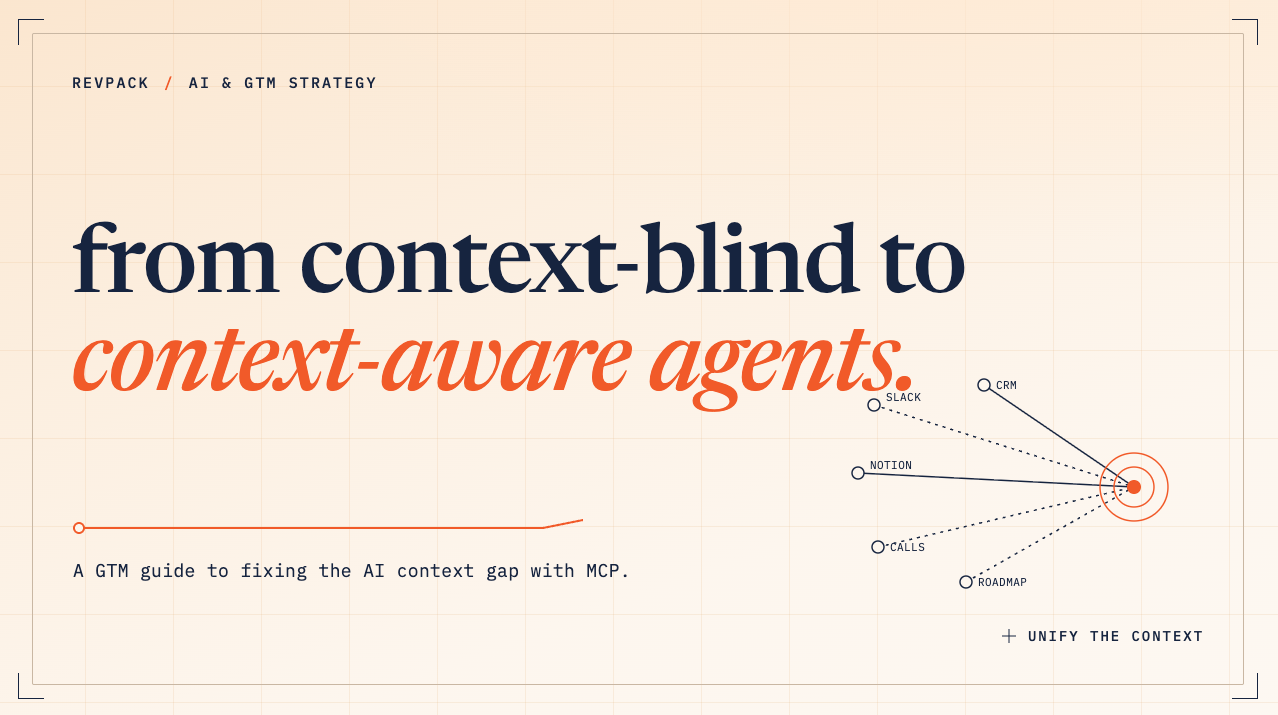
Fix the GTM context gap by moving from static CRM data to a portable context layer that unifies ICP, deal state, and team playbooks. Most AI agents fail because the "why" and "how" of your sales process are trapped in silos like Slack and Notion. By using a context headquarters (example: Unabyss), you can feed your agents a live, machine-friendly "headless brain" via the Model Context Protocol (MCP).
The Data: Why Generic AI is a Liability
AI-driven agents compound errors at machine speed; without a proper context layer, an agent simply amplifies problems at the speed of automation. This isn't just an opinion—it's a technical bottleneck:
The Knowledge Gap: Most AI tools only have access to structured CRM fields, while the information that actually drives wins—objection handling, positioning, and tribal knowledge—lives elsewhere.
The Failure Rate: In zero-shot conditions, CRM-oriented AI agents often see success rates as low as 5% on complex benchmarks because they lack the "guardrails" of structured GTM context.
The Attention Budget: LLMs have a finite "attention budget." Dumping an entire product wiki into a prompt buries high-signal tokens like your ICP or value props under noise.
The Mechanism: Solving the Portability Gap
The reason your AI-generated emails feel generic is that your tools are "context-blind". They might know a prospect's funding round (data), but they don't know which persona cares about that round or how your top rep handled a similar objection last week (context).
Most of this high-leverage context resides in what we call the Portability Gap—trapped in Slack threads, product roadmaps, and the instincts of senior reps. To solve this, you need a "context headquarters" that segments this data and makes it available to every tool in your stack.
Unabyss solves this by connecting hundreds of apps—from Notion to call transcripts—and exposing that knowledge to AI agents using open protocols like MCP. This ensures your sales playbook and account history are always up-to-date in every agent and app you use, transforming your AI from a generic assistant into a context-aware collaborator.
| GTM Layer | Legacy CRM System of Record |
Portable Context ex. Unabyss Model |
RevPack Analytical Take |
|---|---|---|---|
| Data Scope | Static: Name, Stage, Email. | Dynamic: Slack huddles, Notion docs, Win/Loss notes. | Context answers “how” we sell, not just “what” happened. |
| AI Output | Generic / template-driven. | Personalized / context-aware. | Context is the difference between an AI assistant and generic automation. |
| Architecture | Siloed in 23+ apps. | Unified via MCP. | MCP allows the CRM to function as a “headless brain”. |
| Accuracy | Prone to generic or inconsistent outputs. | Grounded in company knowledge and playbooks. | Structured context helps AI deliver more relevant responses. |
Frequently Asked Questions
What is the difference between GTM data and GTM context? Data is the "what"—the company name, recent funding, or deal stage. Context is the "how" and "why"—your ICP definitions, the specific messaging that wins against Competitor X, and the human nuances trapped in your team's Slack or call recordings.
What is the "Context Portability Gap"? It is the problem where 90% of your GTM knowledge lives outside your CRM in disparate tools like Notion, Slack, and email. This makes it impossible for an AI agent sitting in a tool like Clay or Make.com to see the full picture without a unified context layer.
How does Unabyss work with AI agents? Unabyss integrates with your disparate data sources, tags and segments the information, and makes it available via the Model Context Protocol (MCP). This allows any AI (like Claude or a custom agent) to query your live sales playbooks and deal history in real-time.
Why shouldn't I just paste my sales playbook into the AI prompt? LLMs have a finite attention budget. Overloading a prompt with too much noise makes the model less effective at following instructions. A structured context layer retrieves only the relevant slice of information needed for that specific task.
If you are tired of AI agents that sound like robots, it’s time to fix your context layer. We’ve mapped out how we use Unabyss and MCP to build "headless brains" for GTM teams—reach out if you want to see the architecture.
- Anthropic Team — Introducing the Model Context Protocol
https://www.anthropic.com/news/model-context-protocol
Accessed: 23 June 2026 - Anthropic — Introduction to Model Context Protocol
https://anthropic.skilljar.com/introduction-to-model-context-protocol
Accessed: 23 June 2026 - Model Context Protocol Contributors — What is the Model Context Protocol (MCP)?
https://modelcontextprotocol.io/docs/getting-started/intro
Accessed: 23 June 2026 - Model Context Protocol Organization — Model Context Protocol GitHub Repository
https://github.com/modelcontextprotocol
Accessed: 23 June 2026 - Nelson F. Liu, Kevin Lin, John Hewitt, Ashwin Paranjape, Michele Bevilacqua, Fabio Petroni, Percy Liang — Lost in the Middle: How Language Models Use Long Contexts
https://aclanthology.org/2024.tacl-1.9/
Accessed: 23 June 2026 - Nelson F. Liu et al. — Lost in the Middle: How Language Models Use Long Contexts (arXiv)
https://arxiv.org/abs/2307.03172
Accessed: 23 June 2026 - Cheng-Yu Hsieh et al. — Found in the Middle: Calibrating Positional Attention Bias Improves Long Context Utilization
https://arxiv.org/abs/2406.16008
Accessed: 23 June 2026 - Salesforce — State of Sales Report
https://www.salesforce.com/uk/sales/state-of-sales/
Accessed: 23 June 2026 - Salesforce — 40 Sales Statistics to Watch for in 2026
https://www.salesforce.com/sales/state-of-sales/sales-statistics/
Accessed: 23 June 2026 - Emilia David — Anthropic launches Model Context Protocol to standardize AI-data integration
https://www.theverge.com/2024/11/25/24305774/anthropic-model-context-protocol-data-sources
Accessed: 23 June 2026 - Microsoft Developer Blog — Microsoft partners with Anthropic to create official C# SDK for Model Context Protocol
https://developer.microsoft.com/blog/microsoft-partners-with-anthropic-to-create-official-c-sdk-for-model-context-protocol
Accessed: 23 June 2026