What is GTM engineering, and why is it taking off now?
TL;DR
GTM engineering is applying software engineering practices — version control, testing, monitoring, building instead of buying — to the revenue stack. It's taking off because AI tools now let operations people build systems that used to need an engineering sprint, and the money agrees: Clay raised a $100M Series C at a $3.1B valuation in 2025 to make "GTM engineer" a standard role. The catch: the title is hotter than the hiring.
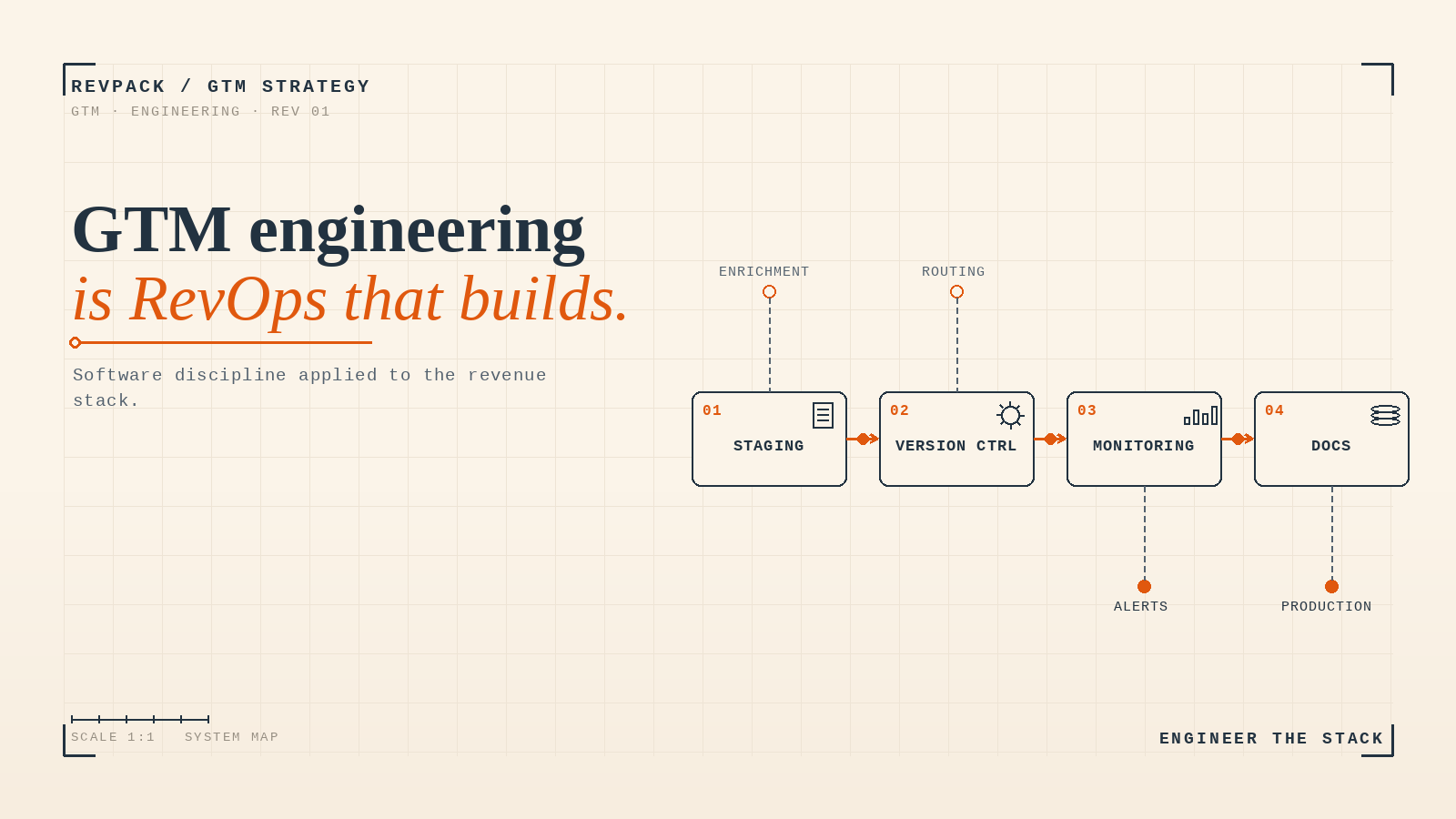
GTM engineering is RevOps that can build
The line between RevOps and GTM engineering is whether you configure tools or build systems. A RevOps person sets up a workflow in HubSpot. A GTM engineer builds an enrichment pipeline that pulls from five sources, dedupes, scores, and writes back to the CRM on a schedule, with monitoring that pages someone when the data contract breaks.
Same goal — a revenue system that runs without humans copy-pasting. Different altitude. GTM engineering borrows the habits software teams already proved out: a staging environment separate from production, workflows you can test before they touch live data, and alerts when something silently stops.
Why now: the build cost collapsed
For years, "build it properly" meant filing a ticket with an engineering team that had a roadmap full of product work. GTM stayed manual because the alternative was waiting two quarters. Tools like Clay, Make, and the current generation of AI agents changed the math — an operator with technical instincts can now build in an afternoon what used to be a sprint.
The capital markets noticed. Clay raised $100M in Series C at a $3.1B valuation in August 2025, led by Alphabet's CapitalG, explicitly to popularize the GTM engineer role. That's the clearest signal yet that this is a category, not a fad.
But adoption is earlier than the hype
Here's the part the breathless posts skip. Kyle Poyar's Growth Unhinged analysis found there's roughly one GTM-engineering job post for every 14 in RevOps, one for every 35 in SalesOps, and one for every 92 SDR roles. And he estimates around 45% of people carrying the title are actually agencies or consultants, not in-house hires.
Read that honestly: the practice is real and growing, but the staffed, in-house GTM engineer is still rare. Most teams should adopt the practices before they hire the title.
| Engineering practice | What it looks like in a GTM stack |
|---|---|
| Staging vs. production | Test workflows in a sandbox before they touch live CRM records |
| Version control | Documented changes to routing and scoring, not silent edits nobody can trace |
| Monitoring & alerts | A page fires when enrichment fill rate or sync volume drops |
| Idempotency | Re-running a job doesn't create duplicate leads or double-fire emails |
| Documentation | A new hire can understand the system without the person who built it |
What to do this week
Pick the one GTM workflow your revenue depends on most — lead routing, enrichment, lifecycle sync — and ask three engineering questions about it. Is there a version you can test before it touches live data? Does anyone get alerted when it breaks? Could a new hire understand it without the person who built it? If the answer to all three is no, you don't need a GTM engineer yet. You need to engineer that one system.
Frequently asked questions
Is GTM engineering just a rebranded RevOps? No. RevOps configures and runs the tools. GTM engineering builds systems with software practices — testing, monitoring, version control. There's overlap, but the difference is building versus configuring.
Do we need to hire a GTM engineer? Probably not yet. In-house GTM engineers are still rare, and roughly 45% of the titled people are agencies. Adopt the practices on your most critical workflow first; hire when you have several systems worth maintaining.
What tools define the space? Clay for data and enrichment, Make/n8n for orchestration, and AI agents for the work that used to need custom code. The tools matter less than treating the output like engineered software.
How RevPack helps
This is the work we do: building revenue systems with the discipline of software — tested, monitored, documented — instead of a pile of brittle automations one person understands. If your stack runs on hope and one operator's memory, that's where we start.
- Clay — "The GTM engineering era begins now" (Series C: $100M at $3.1B valuation), August 2025. clay.com
- Kyle Poyar — "Do you need a GTM engineer?", Growth Unhinged, 2025. growthunhinged.com
GTM engineering applies software discipline — testing, monitoring, version control — to the revenue stack, and it's rising because AI tools collapsed the cost of building. Clay's $100M Series C at a $3.1B valuation is the market signal, but in-house adoption is still early, so adopt the practices before hiring the title.