When should you hire a GTM engineer, and what do they cost?
TL;DR
Hire a GTM engineer when you have repeatable revenue motions that keep breaking because they're held together by manual work and one person's memory — and your product engineers won't prioritize GTM. Reported pay is wide: Clay puts the median around $160,000 (about 20% above traditional sales ops), and Glassdoor's 2026 average is roughly $187,000. Don't hire the title before you have systems worth maintaining.
What a GTM engineer actually does
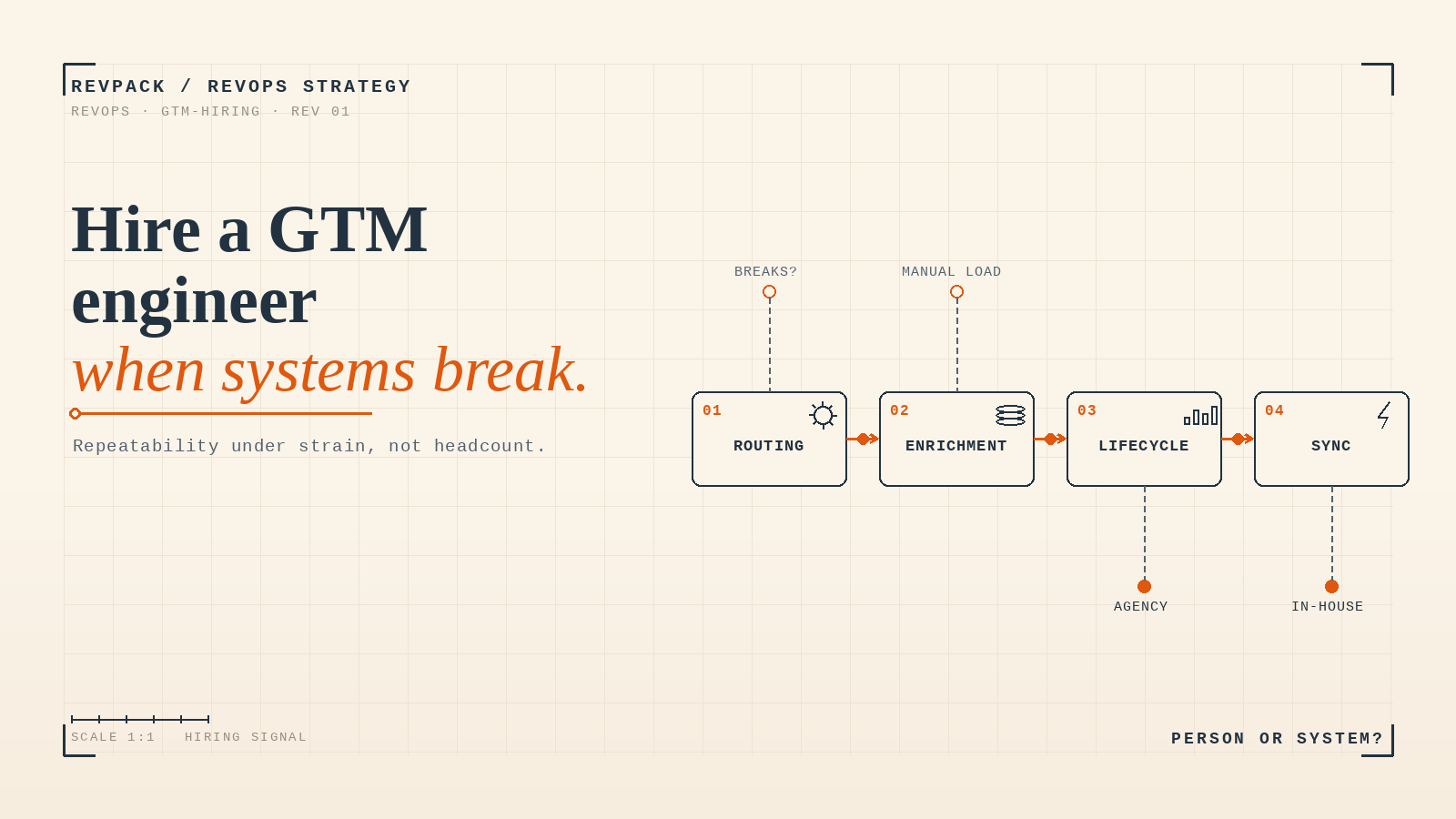
A GTM engineer builds and maintains the systems that move a lead from first touch to closed revenue without a human copy-pasting between tools. Enrichment pipelines, routing logic, lifecycle syncs, scoring models, and the AI workflows now stitched through all of them.
The competencies that matter: data modeling (so records stay clean across systems), automation tooling like Clay and Make or n8n, enough SQL to trust a number, and real fluency in how your sales and marketing motion works. The last one separates a GTM engineer from a general automation hire. Someone who can build a pipeline but doesn't understand why lead-to-account matching matters will build the wrong thing efficiently.
The signal that you're ready to hire
It's not headcount or revenue. It's repeatability under strain. You're ready when three things are true at once:
You have GTM motions that run often enough to be worth automating — daily routing, continuous enrichment, lifecycle transitions. Those motions keep breaking, and every break costs a scramble. And your product engineering team treats GTM work as a distraction from the roadmap, so it never ships.
That third one is why the role exists. GTM work is real engineering, but it loses every prioritization fight against product. A dedicated GTM engineer is how the work actually gets built.
What they cost
Pay data for this role is young and noisy, so treat any single number with suspicion. Clay, announcing its Series C, put the median GTM engineer salary near $160,000 — roughly 20% above traditional sales-operations roles. Glassdoor's 2026 data shows a higher average, around $187,000, with a wide band from roughly $140,000 to $257,000. Other aggregators report lower medians. The spread reflects how new the title is and how much "GTM engineer" means different things at different companies.
| Source | Reported figure (US) | Notes |
|---|---|---|
| Clay (2025) | ~$160,000 median | ~20% above traditional sales ops |
| Glassdoor (2026) | ~$187,000 average | Range ~$140k–$257k; small sample |
| Job aggregators | ~$95k–$130k median | Lower; mixes adjacent titles |
Before you post the job
Run the test from the other side. Roughly 45% of people carrying the GTM-engineer title are agencies or consultants, not in-house hires. For many teams, a fractional engineer or agency is the right first move — you get the systems built without committing to a full-time hire before you know how much ongoing work there is. Hire in-house when the maintenance load is steady, not just when the build is big.
If you're pricing that path, we've published the market rates in how much fractional RevOps costs, and the case for structuring it as a fixed scope before a retainer.
What to do this week
List every GTM workflow that broke in the last month and cost someone an afternoon. If it's one, you have a bug, not a hiring need. If it's five and they all trace back to the same brittle, manual seams, write the job description — or call an agency for the first build and learn the real maintenance load before you commit a salary.
Frequently asked questions
How much does a GTM engineer cost? Reported pay is wide and early: Clay cites a median near $160,000 (about 20% over sales ops); Glassdoor's 2026 average is about $187,000, ranging roughly $140k–$257k. Treat single figures with caution.
When should we hire one? When you have repeatable GTM motions that keep breaking from manual work, and product engineering won't prioritize fixing them. Repeatability under strain, not company size, is the trigger.
In-house or agency first? Agency or fractional first for most teams. About 45% of GTM-engineer titles are already agencies. Hire in-house once the ongoing maintenance load is steady, not just for a one-time build. What fractional RevOps costs sets out the market rates for the alternative.
How RevPack helps
We're often the fractional GTM engineering team companies use before they hire one — building the routing, enrichment, and sync systems, then handing over something documented enough that an in-house hire can run it. If you're not sure whether you need a person or a system, that's a useful conversation to have first.
- Clay — "The GTM engineering era begins now" (Series C; median GTM engineer pay ~$160k, ~20% above sales ops), August 2025. clay.com
- Glassdoor — "GTM Engineer Salary" (US average ~$187k, 2026). glassdoor.com
- Kyle Poyar — "Do you need a GTM engineer?", Growth Unhinged, 2025. growthunhinged.com
Hire a GTM engineer when repeatable revenue motions keep breaking from manual work and product engineering won't fix them. Reported pay is wide — about $160k median (Clay) to $187k average (Glassdoor). For many teams, a fractional/agency build comes first; hire in-house once maintenance is steady.