How do you build a pipeline risk score in HubSpot?
TL;DR
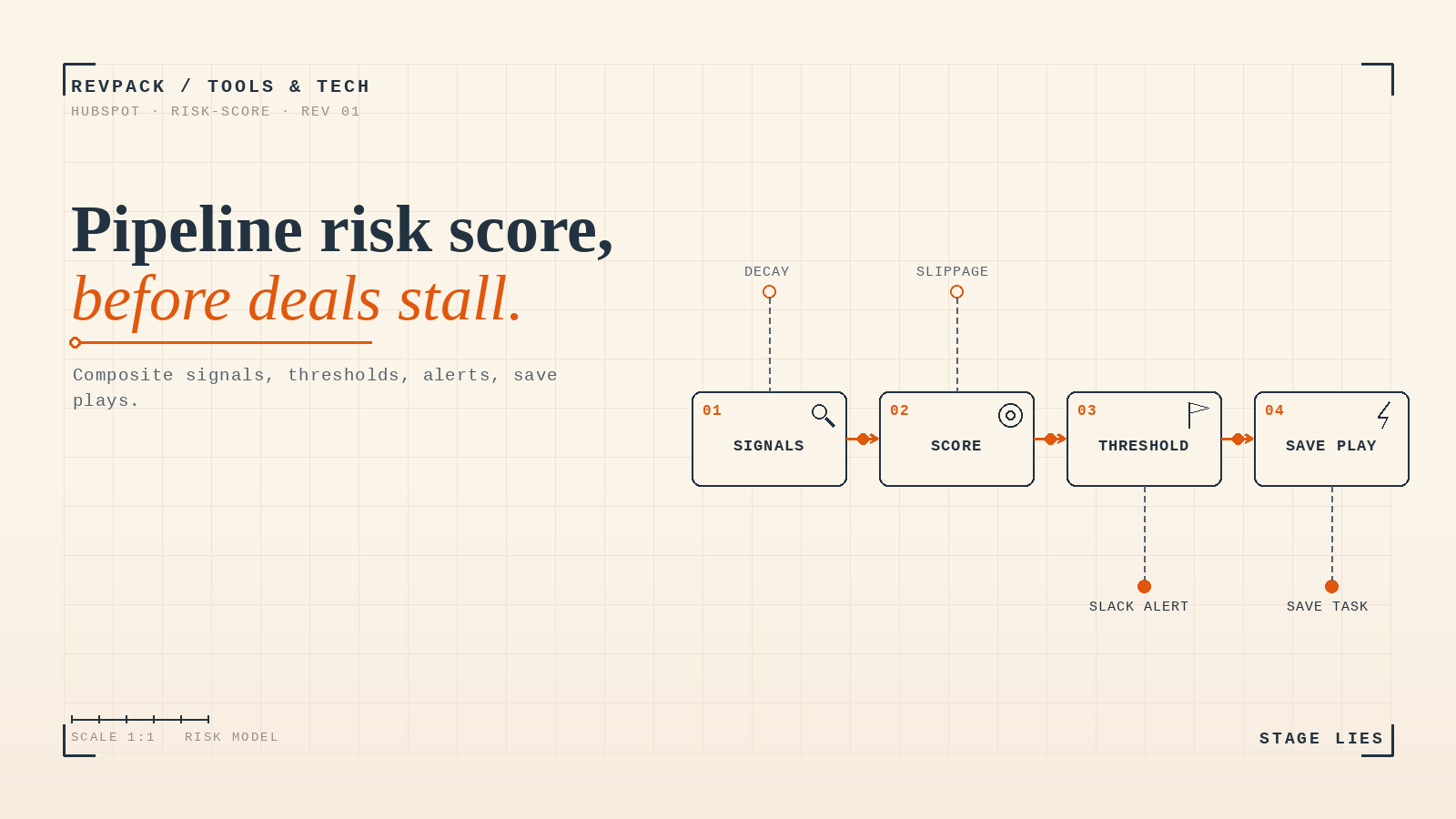
Build a pipeline risk score in HubSpot by combining leading signals — days stalled in stage, buyer engagement decay, single-threading, and slipping close dates — into one score property on the deal. Set thresholds that fire Slack and email alerts plus a save play when a deal turns risky. The deal stage tells you where a deal is; the risk score tells you whether it's actually moving.
Your deal stage is lying to you (politely)
A deal sits in "Proposal Sent," looks healthy in the board view, and quietly dies. The stage didn't change, so nothing flagged it. That's the core problem: stage is a lagging indicator. By the time a deal slides backward or the close date slips for the third time, the risk has been visible in buyer behavior for weeks.
Risk shows up first in what the buyer does, not in what stage the rep set. No replies in two weeks. A single contact carrying the whole deal. A close date that keeps moving right. A composite risk score reads those signals and surfaces the deal while you can still do something.
The mechanism: a composite score on the deal record
HubSpot lets you build a score property on deals from criteria and events (scoring tool). The build is four steps.
First, choose the inputs — the behaviors that actually predict slippage:
- Time in stage. Days past the normal stage duration for deals that close.
- Engagement decay. Days since the last meaningful buyer activity (reply, meeting, doc open).
- Single-threading. Only one contact engaged on a deal above a value threshold.
- Date slippage. Number of times the close date has been pushed.
Second, weight them. Not every signal is equal — date slippage and engagement decay usually predict loss harder than time in stage alone. Assign points so the worst combinations push the score into your risk band.
Third, set thresholds. Define what "watch," "at risk," and "critical" mean as score ranges, and store them in the score property so workflows and reports can read them.
Fourth, wire the actions to the thresholds.
| Risk signal | What it means | Save play |
|---|---|---|
| Engagement decay | No buyer reply or activity in 14+ days | Re-engage with a value nudge; loop in the champion |
| Single-threaded | One contact on a deal above threshold | Multi-thread: get a second stakeholder in |
| Date slippage | Close date pushed 2+ times | Confirm a real mutual action plan with dates |
| Stage stall | Days in stage past normal for won deals | Diagnose the blocker; set the next concrete step |
Alerts and save plays, not just a number
A risk score nobody sees is a vanity field. Connect the thresholds to action. When a deal crosses into "at risk," fire a Slack alert to the rep and their manager, create a task with the specific save play, and surface it on a "deals at risk" view managers actually review. "Critical" escalates: manager loop-in, a multi-thread play to widen the deal beyond one contact, and a documented next step with a date.
Close the loop monthly
The score is a hypothesis until you check it. Once a quarter, pull closed-lost deals and ask whether the score flagged them in time. If risky deals were still scoring clean, a signal or weight is wrong. Adjust and re-run. A scoring model you never recalibrate slowly drifts into noise.
What to do this week
Pull your last ten closed-lost deals and look at the two weeks before they died. Find the common signal — almost always it's engagement decay or a slipped date, not a stage change. That signal is the first input in your risk score. Build the score around what actually predicted your losses, not a generic template.
Frequently asked questions
What signals should a pipeline risk score use? Leading behavioral ones: days stalled past normal stage duration, time since last buyer engagement, single-threading on larger deals, and how often the close date has slipped. These predict loss earlier than stage changes do.
Can you build deal risk scoring natively in HubSpot? Yes. HubSpot's scoring tool creates a score property on deals from criteria and events, which workflows and reports can then read to trigger alerts and tasks.
How often should you recalibrate the model? Quarterly. Check whether the score flagged your closed-lost deals in time. If it missed them, adjust the signals or weights and re-run.
How RevPack helps
We build pipeline risk scoring in HubSpot end to end: choosing the signals that predict your losses, weighting and thresholding the score, and wiring alerts and save plays your reps will actually use. If deals keep dying in "Proposal Sent" with no warning, that's the system we fix.
- HubSpot — "Build lead scores to qualify contacts, companies, and deals," Knowledge Base. knowledge.hubspot.com
- HubSpot — "Sales Pipelines: A Comprehensive Guide for Sales Leaders and Reps." blog.hubspot.com