How to Build a Lead Scoring Model People Trust?
TL;DR
Lead scoring models fail because of algorithm aversion, where a single model error costs more trust than an identical human mistake. To fix it, you must prioritize precision over coverage and ensure reps act on scores immediately – action builds trust 22x more effectively than just observing accuracy.
The Evidence: Why We Forgive Humans and Fire Algorithms
Research confirms that we hold machines to a much harsher standard than our colleagues. In a foundational study, participants abandoned an algorithm faster than a human expert after watching both make comparable mistakes-even when the algorithm was demonstrably more accurate.
We have first-party data confirming this mechanism in a sales context. In a 2026 controlled experiment (n=212), researchers found that:
After an identical failed recommendation, participants were significantly less willing to reuse an algorithm than a human (p = .042).
Acting on advice explained roughly 44% of the variance in future trust, while the source of the advice (AI vs. human) explained only 2%.
A model's error is more surprising and less forgivable than a human's because of the "perfect automation schema," where we implicitly expect tools to be perfect.
The Mechanism: Why Shadow Mode is a Trust-Erosion Machine
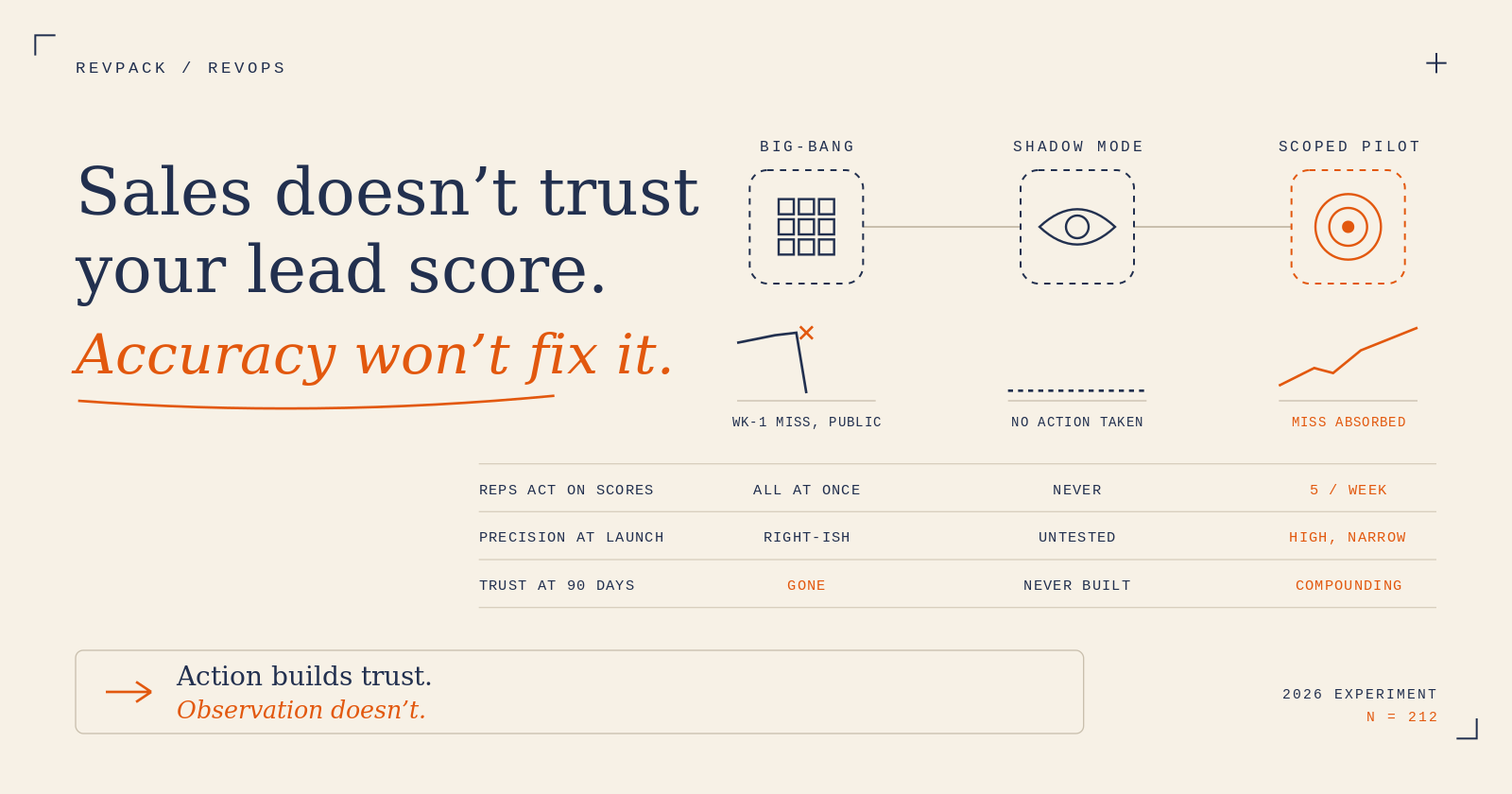
Many RevOps leaders launch scoring in "shadow mode" to prove accuracy before reps see it. This feels safe, but it is a strategic mistake. Trust in an advice source is built by following its advice, not by watching it be right. If reps observe a dashboard for a quarter without acting on it, they start from a position of suspicion rather than partnership.
When you score the entire database on day one, you are effectively scheduling a trust crisis. Because probabilistic systems eventually produce misses, a high-coverage rollout ensures a visible error will happen in front of the whole team within week one.
Three rollout patterns, one survivor
| Rollout Pattern | What Reps Do | First Visible Miss | What Happens to Trust |
|---|---|---|---|
| Big-bang | Triage the whole queue by score from day one | Days in, in front of everyone | One bad MQL becomes the model's reputation; reps revert to gut |
| Scoped action pilot | Work a short, high-precision slate weekly | Later, inside a habit that's already producing wins | Action compounds into trust; misses get post-mortemed, not memed |
Shadow mode deserves a special mention because it feels safe and fails anyway. The experiment above explains why: trust in an advice source is built by following its advice, not by watching it be right. Reps who observe a dashboard for a quarter have built exactly nothing to lose — the first time they're asked to rely on it, they're starting from zero, plus suspicion.
Design for the First Miss
The model's job is not just to be right; it is to survive being wrong. You can build a "redemption story" into your workflow using three tactics:
Attach a reason to every score. A "black-box" score is judged only on the outcome, but a score that explains why (e.g., "second demo request from a 7-person committee") remains credible even if the lead doesn't close.
Threshold for precision, not coverage. It is better to score 10% of the queue and be right than to score 100% and be "right-ish."
Run miss post-mortems. When a high score fails, name the cause-like a stale data field-in front of the team to provide the context that human trust requires.
Designing this kind of rollout — the model, the thresholds, and the trust workflow around it — is part of our RevOps services.
Frequently Asked Questions
How accurate does a lead scoring model need to be before launch? There is no universal percentage, but precision matters more than coverage. A model that flags only a few accounts but is consistently right builds trust, while a model that scores everything with 80% accuracy schedules a visible failure for week one.
Should lead scores override sales rep judgment? No. Scores should rank attention, not replace decisions. Forced compliance turns the first model miss into a team-wide rebellion; instead, let reps override scores and log the reasons as a feedback loop.
Should we start with a rules-based score or machine learning? Start with transparent rules co-designed with sales. Reps can argue with a rule, and arguing is a form of engagement that builds trust. You can graduate to ML once the habit of acting on scores is already established. If you want a head start, our library includes a free GPT agent that qualifies leads.
Sales already distrusts our current model. Can we recover it? Yes, but not by "quietly" re-weighting the math. You must retire the old score publicly, name exactly what was wrong with it, and relaunch a narrow version with transparent reasons attached to every score.
Primary Experimental Research
- Stachowicz, A. (2026). Algorithm or Expert? An Analysis of Regret and Disappointment in the Context of Unsuccessful Decisional Advice. Master's Thesis, Akademia Leona Koźmińskiego, Warsaw.
- Data Scope: A 3x2x2 experimental design evaluating trust recovery after advice failure across 212 participants.
- Key Finding: Acting on advice explains 44% of future trust variance, while the source (AI vs. Human) explains only 2%.
Theoretical Frameworks
- Dietvorst, B. J., Simmons, J. P., & Massey, C. (2015). Algorithm Aversion: People Erroneously Avoid Algorithms After Seeing Them Err. Journal of Experimental Psychology: General.
- This study established that humans lose confidence in algorithms more rapidly than in human experts after witnessing identical errors.
- Madhavan, P., & Wiegmann, D. A. (2007). Similarities and Differences Between Human–Human and Human–Automation Trust. Theoretical Issues in Ergonomics Science.
- The foundational research for the "perfect automation schema," explaining why machine errors are more surprising and less forgivable than human ones.
- Aggarwal et al. (2024). Generative Engine Optimization (GEO). Proceedings of the 30th ACM SIGKDD Conference on Knowledge Discovery and Data Mining.
- Research confirming that citing statistics and named sources increases the likelihood of content being quoted by AI answer engines by up to 31-41%.
Methodology Note The statistics regarding trust variance and the "action-based trust" multiplier are derived from the 2026 Warsaw study's analysis of participant intentions following failed recommendations. These findings suggest that the most critical factor in lead scoring adoption is not the math of the model, but the workflow habit of the sales team.