How do you integrate customer success into your RevOps system?
TL;DR
Integrate customer success into RevOps by writing a customer health score onto the company record in your CRM, not into a separate CS dashboard. Once health lives where routing, alerts, and forecasting already read, sales stops chasing accounts CS knows are at risk, and renewals become a property you can filter, not a quarterly surprise.
The real problem isn't "alignment" but having two databases
Most CS teams run on a tool that never writes back to the CRM. Health scores live in a spreadsheet or a standalone success platform. The CRM that sales and marketing act on has no idea any of it exists. So an AE books an expansion call with an account that opened four P1 tickets last week, and marketing keeps nurturing a customer who hasn't logged in since onboarding.
That's not a culture gap you fix with a shared Slack channel. It's a data gap. The two systems disagree about which accounts are healthy because they're literally looking at different records. A customer health score is supposed to be the single number that tells you whether an account will renew, expand, or churn. It can't do that job sitting in a tool the rest of the revenue team never opens. The same gap breaks alignment between sales, marketing, and customer success.
The mechanism: health as a CRM property, not a CS report
The fix is one architectural decision. The health score has to be a field on the same company record sales and marketing already use, updated on a schedule, and readable by the same workflows that route leads and roll up the forecast.
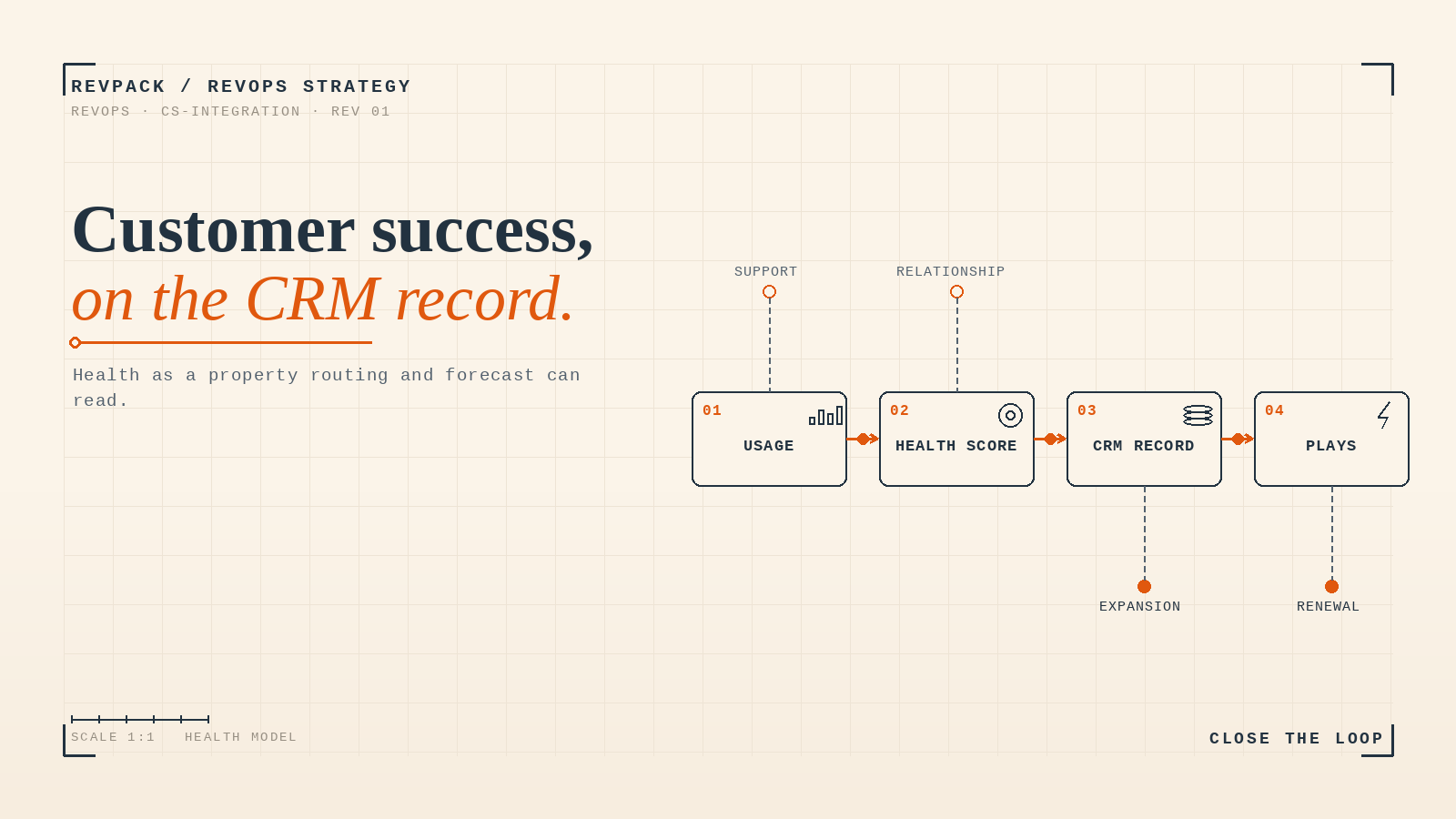
Draw it on a whiteboard: product usage and support data flow into a scoring job, the job writes a number and a tier onto the company record, and your existing automations branch on that field. No new surface for anyone to check. The score shows up where people already work.
Feed the score from signals that actually predict churn and expansion:
- Usage: login frequency trend, depth of feature adoption, seats active versus licensed.
- Support: ticket volume and severity, time-to-resolution, reopened tickets.
- Relationship: executive sponsor engagement, champion still in role, response time to CS outreach.
Keep the inputs few and honest. A score built on twenty weak signals is harder to trust than one built on five that move with renewals.
Who acts on it
Once health is a field, the plays write themselves:
- A high-health account crossing a usage threshold triggers an expansion task for the AE.
- A drop below your at-risk tier fires a Slack alert to the CS owner and pauses any active upsell sequence.
- The forecast filters renewal revenue by health tier instead of treating every renewal as 100% until it isn't.
The point isn't more dashboards. It's that the number lives in one place and everyone's tools read from it. This is the boring version of what Gartner found pays off: teams with advanced RevOps maturity — end-to-end processes mapped to the buying journey, with centralized data — are about twice as likely to exceed their revenue goals. Centralized data is the part most teams skip.
| Dimension | Siloed CS | Integrated into RevOps |
|---|---|---|
| Where health lives | Standalone CS tool or spreadsheet | A field on the CRM company record |
| Who can see it | CS only | Sales, marketing, CS, finance |
| Renewal risk | Surfaces 30–60 days out | Flagged on the record as the score drops |
| Expansion | Spotted by accident | Triggered by a usage threshold |
| Forecast | Renewals assumed at 100% | Filtered by health tier |
What to do this week
Pick your ten largest renewals in the next two quarters. For each, try to answer one question from the CRM alone: what did this customer do in the product in the last 14 days? If you can't, the data is the problem, and no health score will fix it until that signal lands on the record. Wire that one signal first, then add tiers.
Frequently asked questions
Where should the customer health score live? On the company (or account) record in your CRM, as a field. If it lives only in a CS tool, the workflows that route leads and build the forecast can't read it, which is the whole problem.
What signals belong in a health score? Usage trend, feature adoption depth, seat utilization, support ticket volume and severity, and sponsor or champion engagement. Start with five that track renewals and add slowly.
Does this need a separate CS platform? No. The job is integration, not another tool. A scoring job that writes a number onto the CRM record beats a best-in-class CS dashboard nobody outside CS ever opens.
How RevPack helps
We build the wiring: piping product and support signals into a health score that lives on the CRM record, then connecting it to routing, alerts, and the renewal forecast. If your CS data and your CRM disagree about which accounts are healthy, that's the seam we work.
- Gartner — "Revenue Operations: The What, Best Practices & RevOps Guide." gartner.com
- Gartner Digital Markets — "Customer Health Score." gartner.com