We ran 214 cold email campaigns. The list beat the copy by 100x.
TL;DR
Across 214 cold email campaigns we ran in 2026 — about 250,000 prospects — our best and worst outbound differed by roughly 100x in meetings booked per prospect. The variable that moved wasn't copy. It was the list: who got the email, and whether they got it at the right moment. Copy is the last multiplier in the chain; the list sets the ceiling. In outbound, the list is the product. The email is packaging.
Across 214 B2B cold email campaigns we ran in 2026 — roughly a quarter of a million prospects — the distance between our best and worst outbound was about 100x, measured in meetings booked per prospect worked. The variable that moved was the list: who got the email, and whether they got it at the right moment. Copy, subject lines, personalization tokens, sequence length — all of it mattered, and all of it mattered less than fit and timing combined, by two orders of magnitude.
This is our first State of B2B Outbound benchmark. It's built on our own send data, not a survey. A quick note on where it comes from: I've worked in B2B outbound since 2020 — as an SDR, in sales, and now running GTM at RevPack, where my team ran the 214 campaigns behind these numbers. We migrated sending platforms in April 2026, so the figures stitch two windows together: a fully measured window from April on, where we have every send, reply, bounce, and opportunity, and a proxy window back to September 2025, where we kept the meetings but not the raw send counts. Where a figure is a proxy, it says so. Client names are stripped to their industry, because the point isn't the logo — it's the pattern.
Here is the pattern, stated as plainly as we can: in outbound, the list is the product. The email is packaging.
Why the list decides the outcome before you write a word
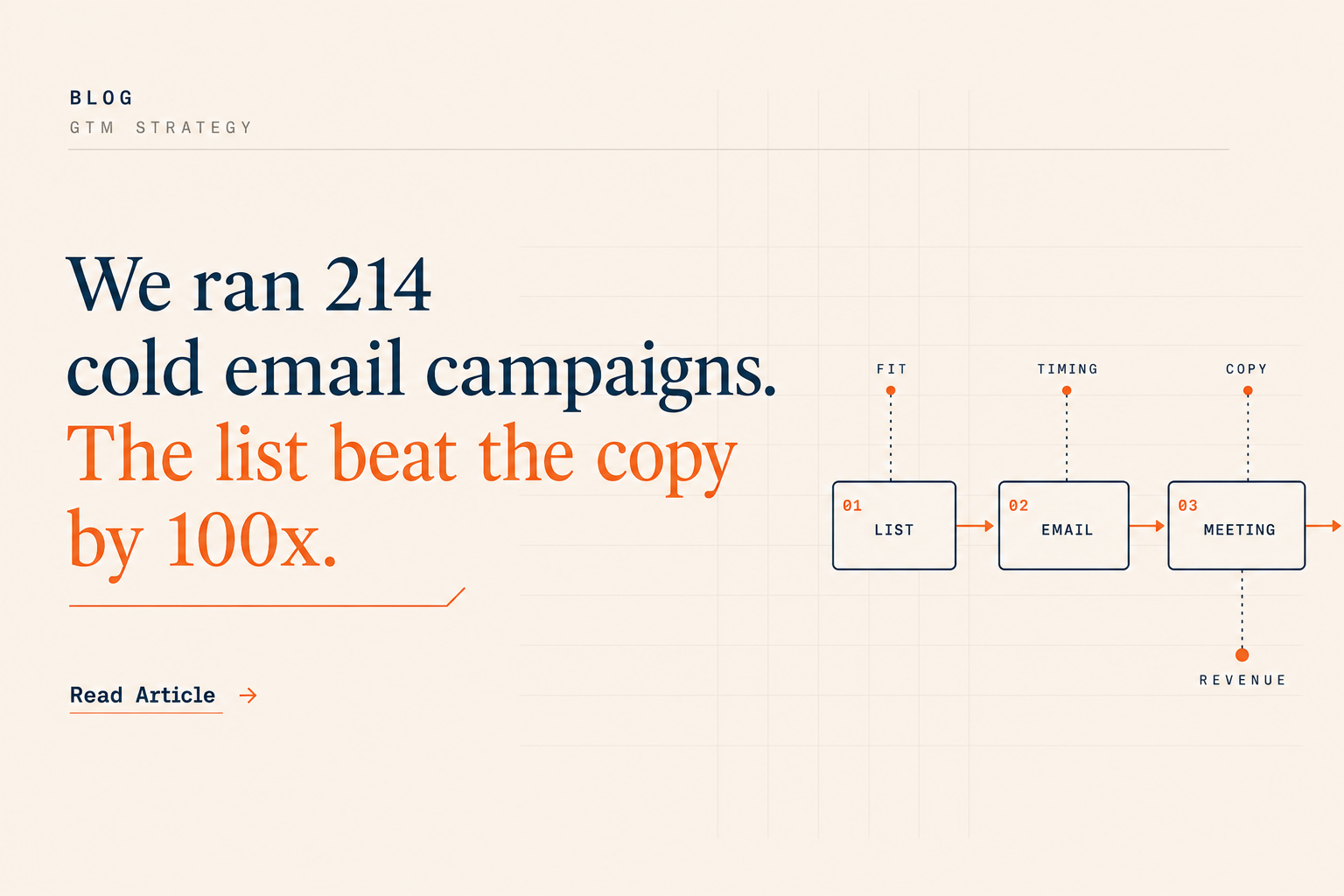
A cold email's result is mostly set before it sends. Three things gate it, in order, and none of them is the copy.
Fit. Does this company have the problem you solve, badly enough to answer a stranger about it? If the answer is no, there is no subject line that fixes it. You can raise a 0.2% reply rate to 0.4% with better writing. You cannot write your way from "wrong audience" to "booked meeting."
Timing. Is the account in motion right now — a new hire in the buying role, a funding event, a tool being ripped out, a job posting that names your category? An email that lands in the week something changed gets read as relevant. The identical email, sent to the identical person, three months earlier or later, gets read as noise. Same words. Different outcome. The only thing that moved was when.
List integrity. Is the data real? A list built from stale or unverified records bounces, and a high bounce rate is rarely just a deliverability problem — it's the same data rot that produces low reply rates, showing up one stage earlier.
Copy operates on whatever survives those three gates. If 90% of your list doesn't fit, isn't in-market, or isn't reachable, your best-performing email is competing for the sliver that's left. This is the mechanism behind the 100x. It isn't that good copy doesn't help. It's that copy is the last multiplier in the chain, and the list sets the ceiling every multiplier after it has to work under.
You can draw it as a funnel where the top gate is list quality and everything downstream inherits its constraint. Most teams spend their time optimizing the bottom of that funnel — the send-time A/B test, the fourth follow-up — while the gate at the top is wide open.
What a meeting costs, in prospects
Reply rate is the shallow number. The honest one is meetings per prospect, because it survives every vanity metric above it. Here is what one booked meeting cost across seven real programs, spanning both platforms and anonymized to approach:
Read the top and bottom rows against each other. The signal-tracked program emailed about ten companies and booked three. The broad program emailed ten thousand and booked twenty-eight. The tight program used fewer emails in a strike than the broad one sent in an hour, and it booked a meeting for nearly one in three companies it touched.
Nothing about the writing explains that gap. The signal program only ever contacted companies that were doing something — a trigger, a move, a moment — inside a market where every account already fit. The broad program contacted everyone in a category and let the copy sort them. That's the whole difference, and it's worth 100x.
This is what "data quality" means in practice. Not a cleaner spreadsheet. A tighter answer to the question of who deserves an email, and when.
How much of this is just the industry you're in?
Some of it. Reply rate varies by vertical before you write anything, and the spread is wide. From the fully measured window, by industry:
Belkins saw the same structural variance in their 2025 study of 7.5 million cold emails, where geography alone swung the average from 1.43% in Poland to 0.51% in the US, and vertical swung it from Food & Beverage at the top toward Banking and Insurance at the bottom, per Belkins' 2026 response-rate study. So yes, some verticals are simply harder, and you should benchmark against your own industry, not a global average.
Two things in our table matter more than the ranking, though.
Reply rate and conversion are not the same signal. Medical devices replied at only 1.06% but produced a 0.51% positive rate — near the top of the table — because a regulated, skeptical buyer answers less often and means it more when they do. Consumer wellness replied nearly three times as often but converted worse. Chase the positive rate. A vertical that replies constantly with "no thanks" is worse than one that replies rarely with "tell me more."
And the largest program by volume sat near the floor. Twenty-one thousand contacts in product design returned 0.42%. Volume did not rescue loose targeting. It never does — it just spends the send budget faster.
Do buying signals work?
Only when the signal confirms a fit you already had. On their own, signals underperformed.
In the measured window, campaigns built purely on ICP fit replied at 0.79%. Campaigns built on a signal — new hire, job change, event attendance — replied at 0.66%. Lower. That result surprised us, because we sell signal-based outbound and expected the triggers to win outright.
The reconciliation is the important part. A signal is not a reason to email someone. It's a reason to email someone who already belongs on your list, right now. A "new hire" trigger fired at a wrong-fit company produces a wrong-fit conversation slightly faster. Our new-hire campaigns aimed at loosely qualified accounts, and the results tracked the fit, not the trigger.
The signal plays that won were the ones layered on genuine fit. The ~30% program in the table watches a market that is already 150 perfect-fit accounts, then times the send to real activity — the list guarantees fit, the signal guarantees timing. The event program didn't email 200 people because they showed up; it scored all 200 against the ICP and worked only the matches. (We go deeper on this in turning buying signals into prioritized outreach.)
This lines up with where the market has landed. Roughly three-quarters of 2025 B2B sales engagements were reportedly triggered by signals like leadership changes, funding, and hiring surges, according to Autobound's 2026 signal-based selling guide — and the operators doing it well are clear that the lift comes from fit plus timing, not from the trigger alone. Fit qualifies whether a signal is even worth acting on. Tech stack, headcount, and org shape earn their keep here: they're how you establish fit at scale, so the signal has something true to sit on top of.
Does a longer sequence get more replies?
In our data, no — and this cuts against the usual advice, so it's worth handling carefully. Two-step sequences replied at 3.57%. Four-step sequences replied at 0.56%.
The consensus says the opposite, and the consensus has good data behind it. Woodpecker's analysis of more than 20 million cold emails found that follow-ups drive a large share of all replies, and that adding a single follow-up lifted reply rates meaningfully. Most practitioners land on three to five touches as the sweet spot. We don't think that's wrong.
What our number reflects is that list quality dominates touch count. Our two-step sequences ran on our tightest, warmest lists, where a reply comes fast because the relevance is obvious. The longer sequences were doing more follow-up because the first email didn't land — and the fifth email to someone who was never going to answer doesn't persuade them, it annoys them. Adding follow-ups is the move teams make instead of fixing the list. It has a ceiling, and past it, more touches cost you sender reputation and goodwill. (Our two-step sample is smaller than the others, so read it as directional, not gospel.)
The takeaway isn't "send fewer emails." It's "a right list needs fewer emails to work, and a wrong list can't be saved by more."
Stop trusting your open rate
We don't track opens, and neither should you. The open-rate pixel fires when a machine loads it, and since Apple's Mail Privacy Protection began pre-fetching images by default, a large share of recorded "opens" are Apple's servers, not humans — MPP affects well over half of all email opens, per beehiiv's breakdown of Apple MPP. The number is noise wearing a suit.
There's a second reason, and it's the one that costs money: the tracking pixel itself hurts deliverability. Belkins dropped open tracking entirely for exactly this reason and moved to measuring replies against total sends. When your deliverability tooling and your metric are working against each other, keep the deliverability and throw out the metric. Measure replies, positive replies, and meetings — and protect the fundamentals of inbox placement and deliverability instead. Those require a human to do something.
What's a good reply rate, then — and why ours look low
Here's where the denominator does all the work, and where most benchmark confusion lives. There is no single "cold email reply rate," because everyone divides by a different number.
We measure against total sends, the stricter basis. On that basis, our working campaigns replied at 1.12% and our tests at 0.46% — and Belkins' 7.5-million-email average of 0.45% sits right at our test floor. That's not a knock on the average. It's what an average looks like when it includes every campaign still searching for fit. Blend all of ours together and the positive rate drops well under 1%, because most campaigns are tests. The winners are what you scale, not the blend.
So when a benchmark tells you "good is 5%," check the denominator before you panic. Against delivered mail, 5% is reasonable. Against total sends, sustained, it's excellent.
Roughly one campaign in five is worth keeping
We ran 214 campaigns in 2026. In the window we can measure cleanly — 109 of them — 23 cleared our bar for scalable, which we define as three or more real opportunities. The other 86 were tests we killed or parked. Apply that ratio across the full year and you get about 40 keepers out of 214. The rest were the search.
On the old platform the pattern was the same: every client took five to ten campaigns before we found one worth pouring volume into. This is not waste. It's the cost of finding fit. Outbound is a search problem before it's a scale problem. Teams that lose commit budget to the first campaign before it's earned it. Teams that win run many cheap tests, kill fast, and scale the few that clear the bar.
When a campaign does clear it, the separation is sharp. Working campaigns replied 2.4x more often than tests (1.12% vs 0.46%) and produced positive replies 4.5x more often (0.36% vs 0.08%) — on the same infrastructure, the same copy standards, the same team. The gap was the list.
Why volume stopped working
The structural backdrop matters, because it's why "just send more" quietly died. On February 1, 2024, Google and Yahoo began requiring bulk senders to authenticate with SPF, DKIM, and DMARC, offer one-click unsubscribe, and hold spam complaints under 0.3%, as documented by MarTech's rundown of the bulk-sender rules. Gmail's filters now weight engagement and relevance, so generic blasts get filtered regardless of how clean the domain is. The economics flipped. A broad, low-relevance list doesn't just convert worse now — it actively damages the sending reputation you need to reach the accounts that fit. Smaller and tighter isn't a stylistic preference. The inbox providers made it the only thing that scales.
The part no agency wants to say: outbound can't fix a bad product
One program in that efficiency table booked 28 meetings from a brutal 10,000-contact list. That's competent execution against a hard market. It still went nowhere — because the client's product couldn't hold the meetings we generated. People took the call, looked at the thing, and passed.
That's the ceiling of this entire discipline. Outbound builds and qualifies pipeline. When the list is right, it puts the right buyer in the room at a show rate we've seen hold above 90% — well above the norm for cold-booked meetings, where no-shows commonly run 30% or worse and a demo show-rate in the 55–65% range is considered healthy, a gap outbound practitioners tie directly to meeting quality. Our 90% isn't a genre benchmark; it's what fast, well-qualified booking off a tight list produces, and we'd rather show you the mechanism than pretend it's typical.
But a booked, held, well-qualified meeting still can't make a buyer want a product that isn't ready. Great outbound exposes a weak offer faster than any other channel. It doesn't repair it. Any agency that won't tell you that is selling you the packaging.
What to do this week
If you run outbound, here's the order of operations the data argues for.
Audit list fit before you touch a subject line. Pull a working campaign and a dead one, and compare who's on them, not what they said. The answer is usually in the list.
Measure positive reply rate and meetings per prospect. Retire open rate from your dashboard today; it's costing you deliverability to track a number a machine generates.
Use signals to time outreach to accounts that already fit, not to justify outreach to accounts that don't. A trigger on a wrong-fit company is a faster way to email the wrong person — which is also why the human/AI handoff matters more than raw automation.
Keep sequences short and let a clean list do the work. If you need five emails to get a reply, suspect the list, not the copy.
Budget for the search. Expect five to ten campaigns per segment before one scales, kill the losers fast, and put your volume behind the small number that clear three real opportunities.
And before you scale spend, pressure-test the offer. Outbound will find your ceiling for you. Don't pay to discover it twice.
The teams that will win outbound in the next few years aren't the ones with the best writers. They're the ones with the tightest answer to a single question: who, and when. Build that, and average copy converts. Skip it, and your best copy is decorating a list that was never going to answer. If you want a second set of eyes on which of your campaigns are worth scaling, that's what we do.
About the author
Will Cyniak has worked in B2B outbound since 2020 — starting as an SDR, moving through sales, and now running GTM at RevPack. This benchmark is built on campaigns his team ran and measured directly. Connect with him on LinkedIn.
Frequently asked questions
What's a good reply rate for B2B cold email in 2026?
Depends entirely on the denominator. Against total emails sent — the strict basis — an average lands near 0.45%, and a healthy campaign clears 1–2% positive replies. Against delivered mail, "good" is roughly 3–5% and "excellent" is 10%+. Always ask which denominator a benchmark uses before comparing yourself to it.
Does targeting or copy matter more in cold email?
Targeting, by a wide margin. Across 214 campaigns, list quality and timing drove a ~100x swing in meetings per prospect while copy standards stayed constant. Copy is a real multiplier, but the list sets the ceiling it works under.
Do buying signals improve cold email?
Only when the signal confirms an existing fit. Signal-only campaigns on loosely qualified lists underperformed pure ICP targeting in our data (0.66% vs 0.79% reply). Signals are for timing outreach to accounts that already fit — not for justifying outreach to accounts that don't.
How long should a cold email sequence be?
Short, if the list is right. We saw two-step sequences beat four-step ones, because our tightest lists reply fast. The broader consensus favors three to five touches, and that holds when the list is colder. Either way, more follow-ups won't save a poorly targeted list.
Should I track email open rates?
No. Apple Mail Privacy Protection inflates opens with machine loads, and the tracking pixel hurts your deliverability. Measure replies, positive replies, and meetings instead — actions a human has to take.
Why does my cold email reply rate look so low?
Probably because you're measuring against total sends and comparing to a benchmark measured against delivered mail. Check the denominator. And remember that a blended rate is dragged down by every campaign still searching for fit; judge yourself on your scaled winners, not the blend.
What changed in B2B outbound in 2026?
Three things. Deliverability rules tightened — Google and Yahoo now require sender authentication and sub-0.3% spam rates. Apple's Mail Privacy Protection made open rates meaningless. And "just send more" stopped working, because inbox providers now weight relevance over volume. Signals went mainstream, but they only work layered on genuine fit.
How should you think about outbound in 2026?
As a search problem before a scale problem. The list is the product; copy is packaging. Run many cheap tests, kill the losers fast, and put your volume behind the roughly one campaign in five that books three or more real opportunities.
Related reading
- Belkins — What Are B2B Cold Email Response Rates? (2026 Study) — 7.53M emails, 0.45% average reply on a total-sends basis; geographic and vertical variance; rationale for dropping open tracking.
- Cleanlist — Cold Email Response Rates: 3.1% Average (2026) — delivered-basis average reply rate.
- Woodpecker — Cold Email Statistics (20M+ emails) — follow-ups drive a large share of replies.
- Autobound — Signal-Based Selling: The Complete Guide (2026) — share of 2025 engagements triggered by signals; fit-plus-timing framing.
- beehiiv — Impact of Apple MPP on Open Rates — share of opens affected by Apple Mail Privacy Protection.
- MarTech — Bulk email restrictions from Google, Yahoo, and Microsoft — Feb 1, 2024 sender-authentication and spam-rate requirements.
- Outbound Kitchen — Your show rate is a meeting quality problem — cold meeting no-show norms and the link to meeting quality.