What is revenue data observability, and how do GTM engineers build it?
TL;DR
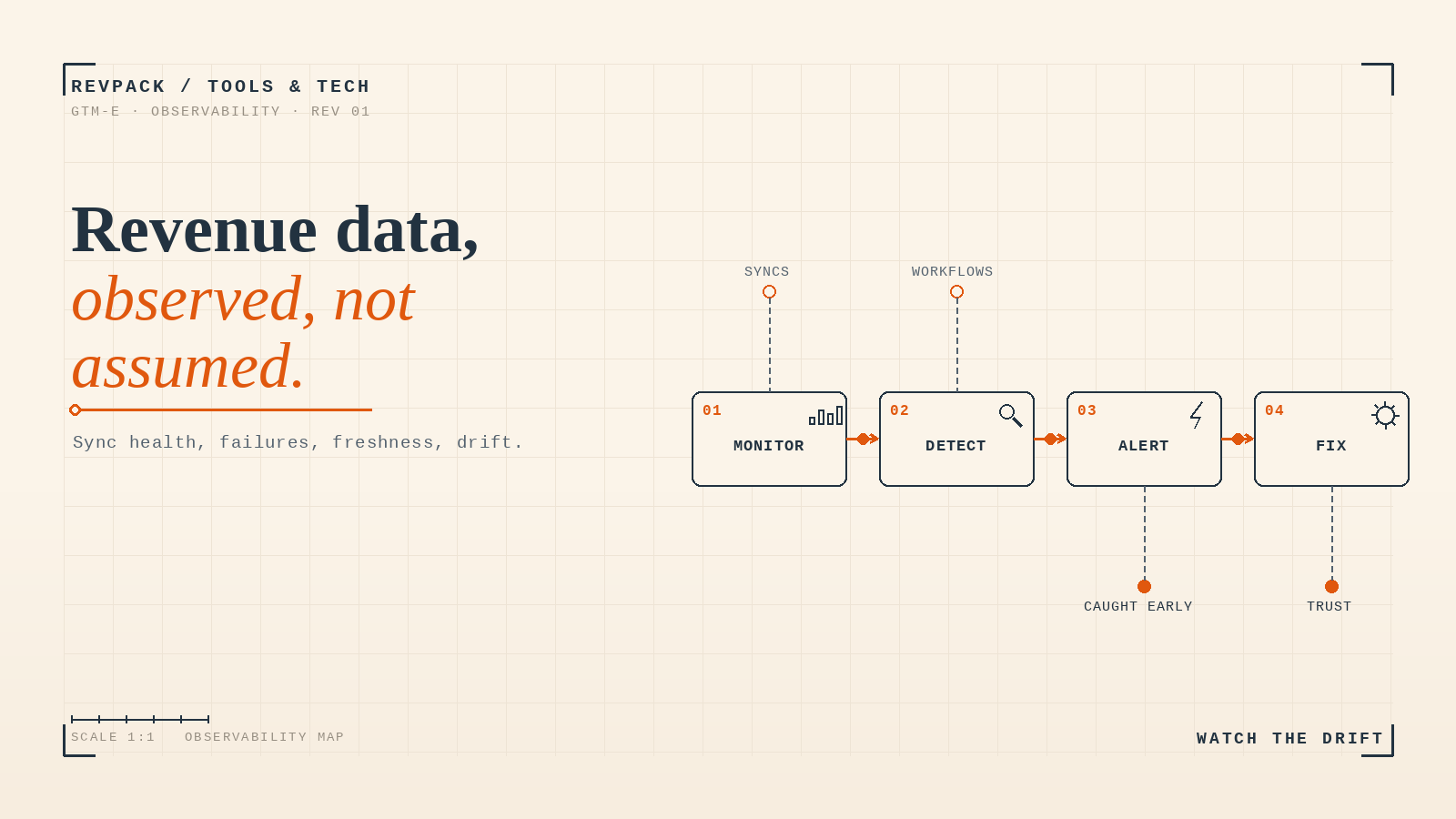
Revenue data observability applies software-style monitoring — metrics, logs, and alerts — to your revenue data: sync health, workflow failures, data freshness, and field drift across HubSpot and the connected stack. Engineering teams would never run a service with no monitoring, yet most revenue teams run their entire data layer blind and find out it broke when the forecast is already wrong. Observability is how GTM engineers catch the break in an hour instead of a quarter.
You monitor your app. Why not your revenue data?
No engineering team ships a service without uptime monitoring and alerts. Then the same company runs its revenue data — the thing the forecast and comp plans depend on — with zero monitoring. A sync silently stops, a workflow quietly fails, a field starts filling with garbage, and nobody knows until a rep or a board deck surfaces it weeks later. Validity found 76% of organizations say less than half their CRM data is accurate — much of that is undetected decay no one is watching for.
The four things to watch
| Layer | What to monitor | Alert when… |
|---|---|---|
| Sync health | Integration runs and latency | A sync stalls or lags |
| Workflow failures | Automation error/skip rates | Failures cross a threshold |
| Data freshness | Last-updated on key fields | Records go stale past a limit |
| Field / sync drift | Value distributions vs. baseline | A field's pattern shifts suddenly |
Sync drift is the quiet one
The hardest failure to catch isn't a sync that stops — it's one that keeps running while slowly writing wrong values. A field mapping changes upstream, and suddenly "country" is filling with region codes, or deal amounts arrive in the wrong currency. Nothing errors; the data just drifts from reality. Watching value distributions against a baseline — and alerting when the pattern shifts — is what catches drift before it poisons the forecast. HubSpot's data sync gives you the sync layer; observability is watching that it stays correct, not just that it runs.
Build it like an engineer would
Treat revenue data as a production system. Define the handful of metrics that signal health (sync success, workflow error rate, freshness, key-field distributions), capture them on a schedule, set thresholds, and route alerts to a human — Slack, email, a dashboard someone actually reads. You don't need a heavy platform to start; a scheduled check that pages someone when a number moves beats the current default of no monitoring at all.
What to do this week
Pick the single most important field in your forecast — deal amount or close date — and set one alert: notify someone if its update volume or value distribution changes sharply. That one alert is the start of observability, and it'll catch the silent break that would otherwise show up in a board meeting.
Frequently asked questions
What is revenue data observability? Monitoring your revenue data the way engineers monitor software — tracking sync health, workflow failures, data freshness, and drift, with alerts — so breakage is caught in real time instead of discovered when the forecast is already wrong.
What's the difference between a sync working and a sync being correct? A sync can run successfully while writing wrong values after an upstream change — that's drift. It throws no errors, so only monitoring value distributions against a baseline catches it.
Do you need a dedicated tool for data observability? Not to start. Scheduled checks on a few key metrics — sync success, workflow errors, freshness, field distributions — with alerts to Slack or email beat the common default of no monitoring. Add tooling as the stack grows.
How RevPack helps
We build revenue data observability for GTM teams: monitoring for sync health, workflow failures, freshness, and drift across HubSpot and your stack, wired to alerts a human sees. If you only learn your data broke when the forecast is wrong, that's the blind spot we close.
- Validity — "The State of CRM Data Management in 2025" (76% say under half their CRM data is accurate). validity.com
- HubSpot — "Connect and use HubSpot data sync," Knowledge Base. knowledge.hubspot.com
Revenue data observability applies engineering-style monitoring — metrics, logs, alerts — to sync health, workflow failures, data freshness, and drift across HubSpot and the stack. The hardest failure is sync drift: a sync that runs while writing wrong values. Start with one alert on your most important forecast field.

