How do you bring an engineering mindset to RevOps?

TL;DR
Bring an engineering mindset to RevOps by borrowing five software habits: keep a change log, test in a sandbox before touching production, make jobs idempotent, monitor for failures, and document so the system outlives the person who built it. You don't need to code — these are practices, not a programming language. They're the difference between a stack that scales and one that breaks every time someone edits a field.
Most RevOps breakage is a process problem
The typical RevOps stack breaks because changes happen with no engineering discipline: someone edits a live workflow, no one logs it, nothing tests it, and three weeks later a sync is quietly broken. Software teams solved these exact problems decades ago. You don't need their tools so much as their habits.
The five habits
| Problem | Engineering habit | In RevOps |
|---|---|---|
| Untraceable changes | Version control | A change log: what, who, when, why |
| Changes break prod | Staging environment | Test in a sandbox or on test records |
| Re-runs double data | Idempotency | Jobs that can run twice safely |
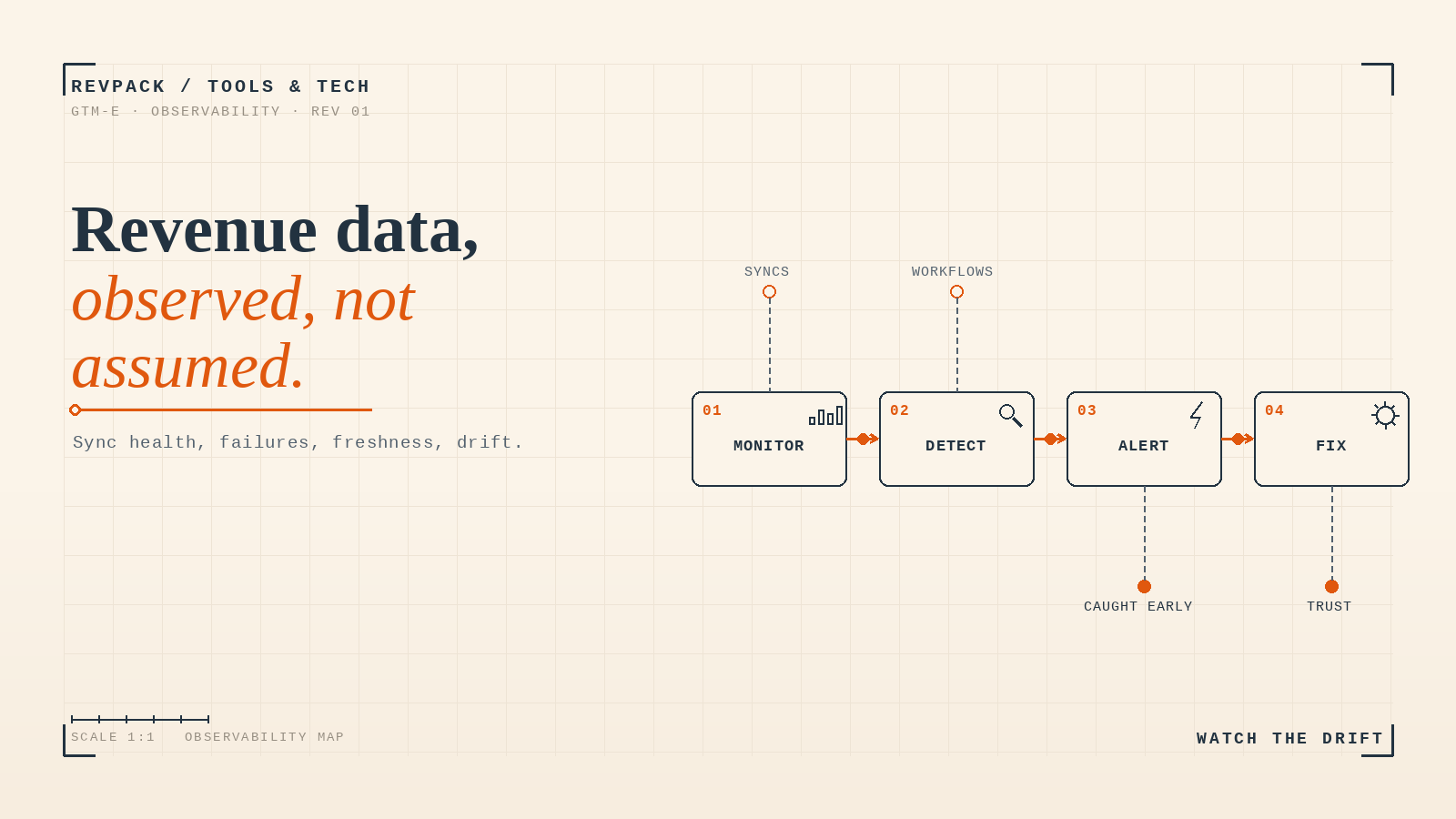
| Silent failures | Monitoring & alerts | Alert when a sync or fill rate drops |
| Bus-factor of one | Documentation | Docs a new hire can follow |
Start with the change log and the sandbox
If you adopt only two, make them these. A simple change log — even a shared doc noting every change to routing, scoring, and stage definitions — ends the "why did this break?" investigations. And testing in a sandbox or on a handful of test records before touching live data stops the most common disaster: a workflow edit that quietly corrupts production. Neither requires code; both prevent most incidents.
This is what GTM engineering really means
The label "GTM engineer" gets attached to tools, but the substance is exactly these habits applied to revenue systems. It's why the discipline is having a moment — Clay raised a $100M Series C partly to make the role mainstream. But you can adopt the mindset today, on the stack you already have, without hiring anyone. The habits travel; the title is optional.
What to do this week
Start a change log for your revenue-critical systems — CRM workflows, routing, scoring — and require one line per change: what changed, who, when, why. It costs minutes and it's the single highest-leverage engineering habit you can adopt in RevOps. Add the sandbox-test rule next.
Frequently asked questions
Do you need to code to bring engineering thinking to RevOps? No. The value is in the practices — change logs, sandbox testing, idempotency, monitoring, documentation — not in programming. They apply to no-code stacks just as well.
What's the highest-impact engineering habit for RevOps? A change log plus testing in a sandbox before production. Together they prevent most RevOps incidents: untraceable breakage and live-data corruption from untested edits.
How is this different from just hiring a GTM engineer? A GTM engineer brings these habits, but you can adopt the mindset now on your existing stack. The practices deliver most of the value; the dedicated hire scales it once you have systems worth maintaining.
How RevPack helps
We install engineering discipline into RevOps teams: change management, sandbox testing, idempotent jobs, monitoring, and documentation — so the stack stops breaking on every edit. If your systems run on one person's memory, that's the practice gap we close.
- Clay — "The GTM engineering era begins now" (Series C; popularizing the GTM engineer role). clay.com
- Gartner — "Revenue Operations: The What, Best Practices & RevOps Guide." gartner.com
An engineering mindset in RevOps means five software habits applied to revenue systems: a change log, sandbox testing before production, idempotent jobs, monitoring with alerts, and documentation. No coding required — start with the change log and the sandbox, which prevent most incidents.